
Key Takeaways
- Multiple parts make up BPO pricing. The structure you select determines your total cost.
- The two parts of a quote that have the most impact are how many hours you request coverage for and the number of languages you require.
- Minute-based BPO pricing is best suited for low-volume work done in English. Coverage-based plans are for complex or multilingual support.
- Shared answering plans can be published. Dedicated programs must be quoted, as the scope will impact the cost.
The hourly rate that seems the most economical usually is not. The true cost is determined by attrition, transition time, and scope creep. - Ask for the BPO pricing calculation, not just the total. A provider who cannot show you the math is leaving something out.
Most likely, you have asked three separate providers the same question and received three answers that cannot be reconciled.
One answered per minute. One answered per agent. One sent a proposal that included a setup fee, a supervision fee, and a technology line that you never requested.
That is the nature of BPO pricing for 2026. The industry is growing rapidly, and there are many opportunities.
Grand View Research forecasts that the global business process outsourcing market will reach $525.23 billion by 2030, growing at 9.8% annually. However, pricing remains the least standardized area of BPO.
So, how much does BPO cost and why is it so difficult to give an instant answer? It’s because every purchase is different.
This article explains every BPO pricing model, all the variables that can affect a quote, and the most effective way to evaluate proposals that look dissimilar.
Want to know what something costs for you? Get in touch, and we can run a quote with you.
What Is BPO Pricing, And What Are You Paying For?
When we refer to BPO pricing, we’re talking about how individual BPO vendors charge their customers. A price list is not the same as a BPO pricing structure. Different service providers typically use different formulas to price the same service.
Outsourcing a business function, such as customer support, is considered business process outsourcing (BPO). Factors such as the cost of agent time, quality assurance, technology, and the service provider’s margin are the cost components of BPO.
How different service providers package these costs determines the competitiveness of offers. One service provider may offer an all-inclusive hourly price.
Another may separate supervisory and technology costs from the hourly price. Both offerings are legitimate. Both offerings make comparison shopping difficult.
For this reason, the same proposal can look very different from a competing offer. Understanding the models described below is the only way to distinguish between a low proposal and an incomplete one.
Which BPO Pricing Models Do Providers Use?
There are five primary models that vendors use to determine pricing for BPO services. Each of these models creates different incentives and is suited to a particular structure of a support operation.
| Model | How you are billed | Best suited to | Main risk |
|---|---|---|---|
| Minute based | Per minute of live agent talk time | Low, unpredictable call volume | Costs spike in a busy month |
| Hourly or coverage based | Per hour of agreed coverage | Steady volume, defined hours | You pay for quiet hours too |
| Full-time equivalent | Per dedicated agent per month | High volume, ongoing operations | Slow to scale down |
| Project-based pricing | Fixed fee for a defined scope | Migrations, backlogs, campaigns | Scope creep eats the margin |
| Outcome based | Per resolved ticket or result | Mature programs with clean data | Hard to define fairly at the start |
Minute-Based Pricing
You pay only for the time an agent spends on your calls. Nothing else. This suits unpredictable call volume. If calls are infrequent, you won’t be billed much for the month. Shared agents lack product knowledge and rely on scripts.
Hourly and Coverage-Based Pricing
You agree on the hours you need covered. You pay for them whether the phone rings or not. This is the most common BPO pricing structure for dedicated support. It gives you a steady monthly figure and an agent who belongs to your account.
Full Time Equivalent Pricing
Also called per-agent or per-seat pricing. You buy headcount with a minimum commitment. It is the simplest model to budget for and the hardest to exit. Read the notice period closely.
Project-Based Pricing
A set amount of money charged for a set task, for example, clearing a support backlog. Issues arise if the work is not clearly defined, because any undefined work becomes “scope creep” and the chargeable work is redefined.
Outcome-Based Pricing
The customer is charged based on the number of resolved problems, qualified leads, or completed work. This pricing method is becoming more popular.
According to Deloitte, the use of outcome-based pricing models grew from 45% to 67% among the 500+ surveyed executives over two years.
This method only works once trust has been established with the data being reported. This pricing method is usually not the right choice for an initial contract.
What Factors Determine Your BPO Cost?
Six variables set your BPO pricing before any number is even stated. Answers to these variables really help in getting an accurate number and should be discussed during the first meeting.
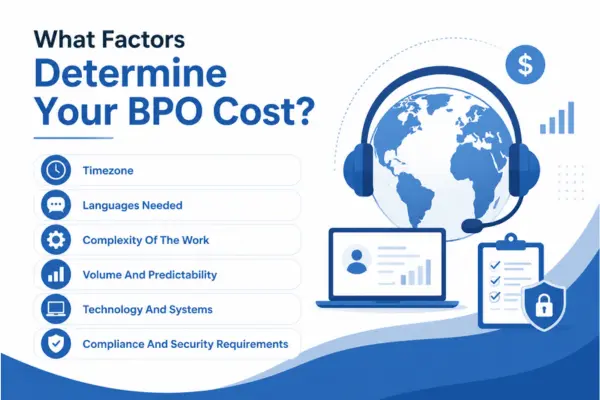
Hours Of The Day And The Time Zone
Business hours, even if only Monday to Friday, are typically the least expensive. 24/7 coverage across three time zones can be several times more expensive than business hours. This requires multiple overlapping shifts and nighttime workers and is often more costly.
Languages Needed
The most cost-effective offering is English-only. The cost goes up if a customer needs support in other languages. The Dutch and German languages, as well as Japanese, for example, are more costly. This is the factor that customers underestimate the most.
Complexity Of The Work
An example of a less complex task is answering a question about business hours. Fixing a device is an example of a more complex task. Complex tasks prolong training, increase the need for quality checks, and require more senior agents.
Volume And Predictability
Staffing based on “spiky” contact volume is more costly than staffing based on consistently high volume.
Providers use an Erlang model to size teams based on the anticipated contact pattern. Unpredictable demand forces a staffing buffer, and you pay for it.
Our Erlang staffing calculator demonstrates how drastically the required headcount can fluctuate with contact volume.
Technology And Systems
If you have a CRM or ticketing system, agents can work from within those systems. If the provider is responsible for the telephony or helpdesk, these would be additional costs. Determine which side of the line each tool falls on.
Compliance And Security Requirements
Law and compliance add to the cost of doing business. GDPR in Europe, PIPEDA in Canada, and CCPA in California impact how data is handled. PCI DSS applies as soon as data containing card details enters a call. Compliance costs time and money and includes staffing, auditing, and training.
How Does Agents Republic Structure Its BPO Pricing?
Agents Republic is a Canadian BPO with a Vancouver head office, a Toronto sales office, and a European office in Budapest. There are two distinct pricing models to choose from. Deciding between them is the most significant aspect of the pricing negotiations in the BPO industry.
Shared Support | The Minute-Based Pricing Model
This model is designed to serve clients requiring a high degree of flexibility and low volume. It is designed to serve clients through simple, repeatable interactions. Every plan is English only.
| Plan | Monthly | Included minutes | Coverage | Channels |
|---|---|---|---|---|
| Bronze | $250 | 200 | 8 hours, 5 days | Phone |
| Silver | $550 | 500 | 12 hours, 5 days | Phone, email, chat |
| Gold | $950 | 1,000 | 24/7 | Phone, email, chat, SMS |
| Platinum | $1,950 | 2,500 | 24/7 | Phone, email, chat, SMS |
All plans come with first 30 days offers, from $99 on Bronze to $999 on Platinum, and you can opt out whenever you want. It takes around twenty minutes to complete the six steps of the process.
The answering service for small business is anchored by this option, which is why it is popular.
What The Published Plans Reveal About BPO Pricing
Divide each monthly fee by its included minutes, and the volume curve appears at once.
| Plan | Effective cost per included minute |
|---|---|
| Bronze | About $1.25 |
| Silver | About $1.10 |
| Gold | About $0.95 |
| Platinum | About $0.78 |
Higher volume buys a lower unit rate. That principle underpins every BPO pricing model, including dedicated contracts, and is why volume is one of the six factors above.
One thing you can borrow when you generate your vendor questions is this: billing is based on talk time plus after-call work. Wrap-up minutes are real work, and a provider who omits them from the quote will add them to the invoice.
Dedicated Support | The Coverage-Based Route
For larger volumes and multi-channel work that may include technical troubleshooting or complex services, this option provides dedicated support. Agents are exclusively assigned to your account.

Agents are trained on your services, products, and service offerings and can use your CRM, ticketing systems, and knowledge base at no additional cost.
Pricing is not minute-based. The calculation is straightforward:
Agent hourly rate × required coverage hours + a fixed monthly supervision fee.
The salary is based on the agent’s experience, location, language, and skills. If you need Monday to Friday, 9 to 5, we cost agents against that schedule and add the supervision fee. That is your estimate. Technology is an added cost if provided by us.
Few providers mention this: as the agent component tracks coverage hours, your invoice will fluctuate from month to month. February is a less expensive invoice for a 28-day month.
| Shared support | Dedicated support | |
|---|---|---|
| Billing basis | Minutes used | Coverage hours agreed |
| Agents | Shared pool | Assigned to your account |
| Languages | English only | Over 100 languages |
| Channels | Phone | Phone, email, chat |
| Product training | Script based | Trained on your systems |
| Best for | Simple, lower volume | Complex or multilingual |
Is Outsourcing Actually Cheaper Than An In-House Team?
It is, but not for the reason most assume. The real saving is in what you no longer spend on.
An in-house team means hiring, payroll, benefits, workspace, phone licences, supervision, and cover for holidays and sick days. A BPO folds all of it into one line. That is why 80% of executives plan to maintain or increase investment in third-party outsourcing.
There is a balance. According to Deloitte, about 70% of companies brought some of their outsourced work back in-house over the last five years, largely either to improve the quality of their work or because of the vendor’s markup.
How Do You Compare BPO Quotes Fairly?
Comparing BPO quotes is tough because pricing rarely matches across the quotes you see. The six steps:
- Every quote should be transformed to a single unit. Cost per covered hour works best. Divide the monthly amount by the hours you covered.
- Find out what is not included. Typically, the gaps include set-up, training, technology, after-hours access, etc.
- See whether supervision is bundled or a separate cost. A low agent rate with a high management fee should not be considered a low rate.
- Learn the terms surrounding the notice period and scaling. Scaling up is easy, but scaling down is when contracts bite.
- Test whether the language claim is valid. Find out which languages are native and which languages are provided through a partner.
Request a sample invoice. Invoices provide line items proposals lack.
Our RFI call center outsourcing questionnaire helps you turn this into a well-documented request for information to send to multiple service providers.
Our guide to call center outsourcing explains how to craft a deal that protects you from those issues.
Final Thoughts
BPO pricing may appear to be riddled with secrets from the outside, but it becomes clearer once you know what to ask. Get the formula and not the final answer.
Find out which hours, languages, and systems are included. Then transform each proposal into cost per covered hour.
Do that and BPO pricing stops being a guessing game. It becomes a decision about how much coverage you need, and in how many languages.
Ready to see the calculation for your own operation? Get a quote from Agents Republic or call +1 (604) 210-8100.
Frequently Asked Questions (FAQs)
How much does BPO cost for a small business?
Most owners are surprised by the low costs of BPO. For low-volume activity, a minute-based plan is the most economical, as you pay only for airtime. For higher call volumes, a coverage-based plan becomes more cost-effective.
Which BPO pricing model is the least expensive?
For low-volume activity, a minute-based service is the least expensive. For a coverage-based service, the cost becomes more economical as the volume of calls increases to the point where you would be purchasing a block of minutes.
Is project-based pricing good for ongoing support?
Rarely. Project-based pricing typically involves a fixed scope and definite end, whereas ongoing support does not.
Why do providers publish some rates, but not others?
Shared plans, which represent most of the services, can be published because they are fairly standard. Dedicated programs vary widely in BPO cost based on language, time and compliance.
Do I need to pay the provider for access to CRM?
With Agents Republic, no dedicated Agents access your CRM, ticketing, and knowledge base at no additional cost. You only pay for the technology we provide.

