
Key Takeaways
- Nearshore teams work normal U.S. business hours.
- A bilingual nearshore call center can handle English and Spanish callers simultaneously in the same call queue.
- Dedicated Spanish teams are charged at hourly rates plus a monthly supervision fee.
- Check dialect fit, data protection, and quality reporting before you sign.
How many of your customers would rather speak Spanish? In 2024, 68 percent of U.S. Latinos spoke Spanish at home, while 71 percent spoke English proficiently. This is why many companies are now opting for a nearshore Spanish call center in Latin America.
The guide explains why U.S. businesses and Canadian-based brands that market to the U.S. choose Spanish nearshore outsourcing, which countries they use, and what to consider.
Want an estimate? Get a quote.
How Latin American Support Teams Help U.S. Businesses Serve Spanish-Speaking Customers
Following are some of the ways the Latin American support team can help businesses support their Spanish audience efficiently.
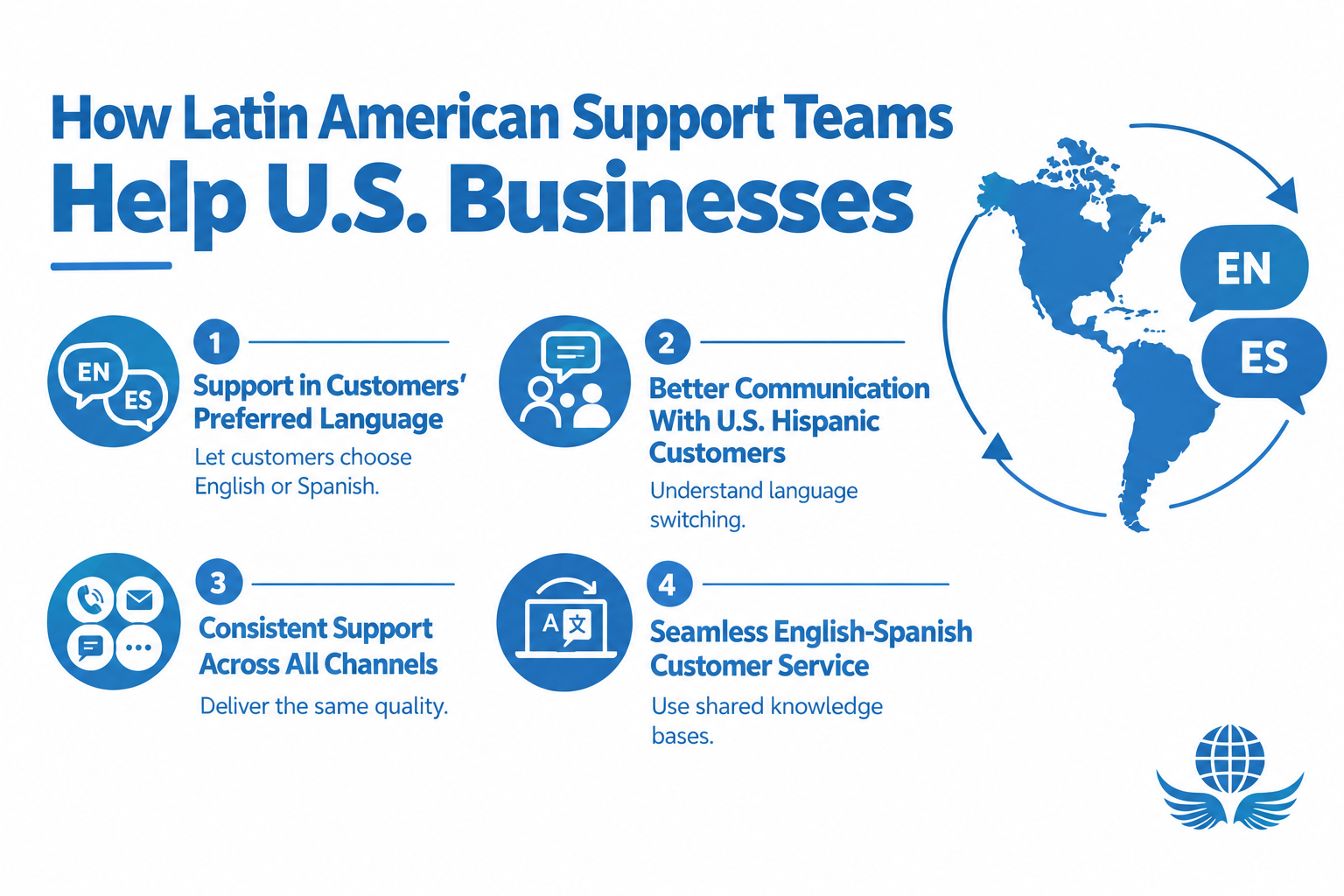
Providing Customer Support in Customers’ Preferred Language
Offer a language option at the start of every call and chat. Add it to your CRM to ensure that when they call again, they will get the proper agent. Spanish customer support nearshore makes this easy to staff.
Improving Communication With U.S. Hispanic Customers
Many U.S. Hispanic customers switch between English and Spanish. Agents who follow that switch avoid transfers.
Delivering Consistent Support Across English and Spanish Channels
For Spanish customer support, use a single knowledge base, rule set, and scorecard for both languages. Then match answers across channels.
Why Nearshore Outsourcing Makes Sense for U.S. Companies
Nearshore teams offer many of the savings of an offshore team, with much shorter time lags.
Real-Time Collaboration With U.S. Teams
A Spanish nearshore call center team lets product and support leads meet live. If the rules change at 10 a.m., it will take until noon for each agent to be notified.
Convenient Business Hours and Shift Coverage
Standard shifts in the region cover U.S. business hours. Evening and weekend shifts are simpler to staff than night work.
Faster Training, Feedback, and Performance Management
Trainers can participate in sessions live. First-call resolution and CSAT reviews occur weekly during normal hours.
Flexible Staffing as Customer Demand Changes
There is a very favorable workforce availability in the region. Agents can be added during launches or holidays and reduced thereafter. See our guide on scaling customer support.
Why U.S. Businesses Choose Latin American Support Teams
U.S. companies choose these teams for cost, language, hours, and culture. Wages are often lower than in the U.S., so the same budget buys more hours. All agents speak Spanish as a native language, with many also having a very good level of English.
Since most of the area operates in or around U.S. time zones, agents respond to callers the same day. Cultural affinity is also useful. Many agents are familiar with U.S. brands and habits, and their phone calls sound authentic. These are some of the reasons for the rise of Spanish nearshore outsourcing. The model is not ideal.
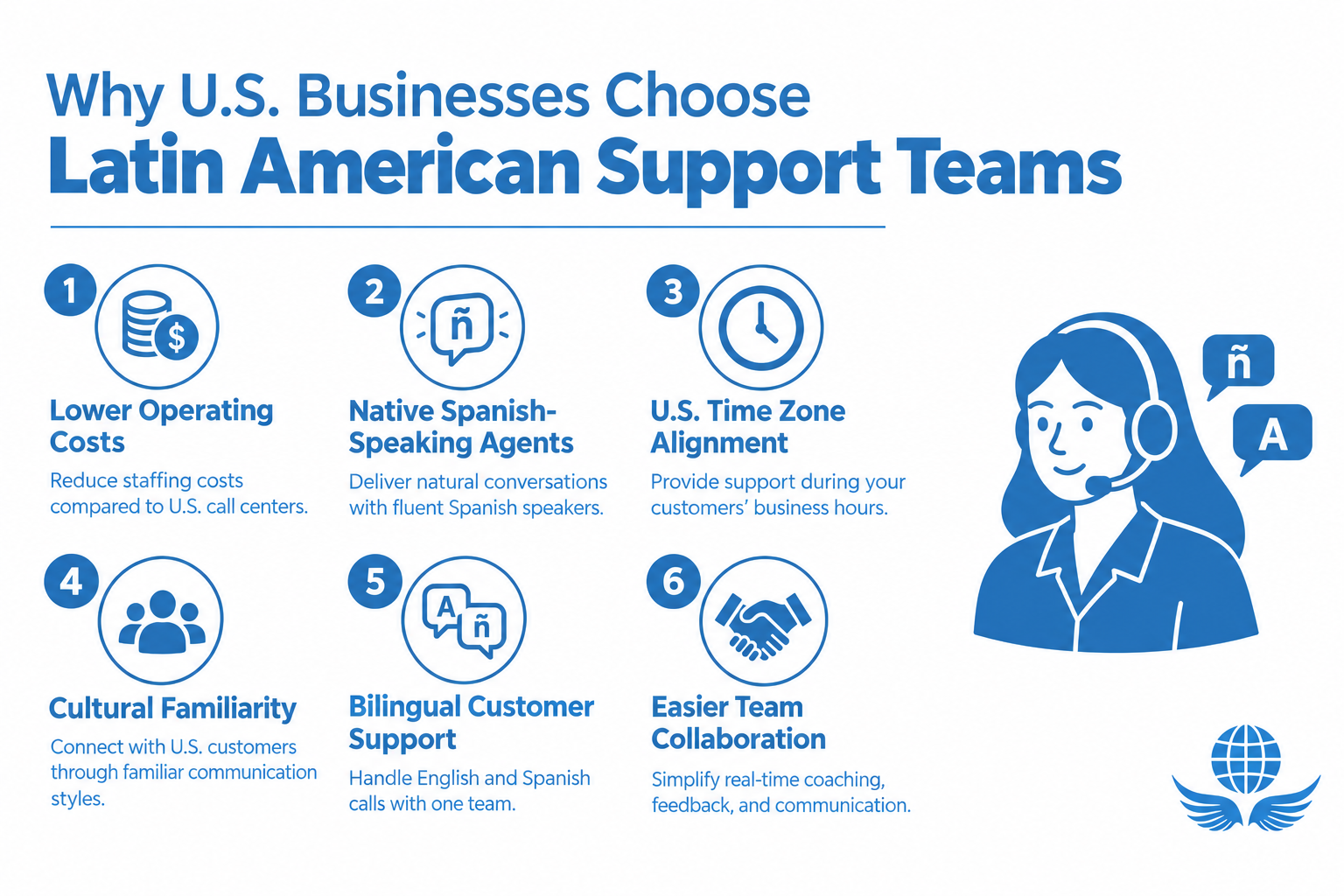
Recruitment, induction, and staffing are vital to quality. Dialects differ, as do the data rules governing each country. A good partner will anticipate these risks from the get-go. It also allows you to support callers in their native language. Below are six benefits that will show you how each works.
Lower Operating Costs Compared to U.S. Call Centers
U.S. labour costs a lot. In May 2025, the median hourly wage for U.S. customer service workers was $21.53 (exclusive of benefits and costs). The region often offers lower wages, resulting in real cost savings.
Access to Skilled Spanish-Speaking Agents
Spanish is the first language across most of the region. Spanish-speaking agents know how to handle tone, slang, and complaints right off the bat, as they are native speakers. A learner is rarely able to.
Time Zone Alignment With the United States
Timezone alignment is a fundamental aspect of nearshoring. Colombia is on the same time as Eastern Standard Time, and Mexico City and Central America are on the same time as Central Standard Time. Agents work your hours, not a late-night shift.
Cultural Familiarity With U.S. Customers
Many agents grew up with U.S. brands, sports, and media. They understand how U.S. customers will be treated, and training is shorter.
Bilingual English and Spanish Customer Support
Bilingual agents can work both of their languages in one queue. If a customer switches languages during a call, they don’t switch agents.
Easier Communication and Team Collaboration
Your managers can contact the team during the day. Feedback and coaching are on the same day, not the next morning.
Which Latin American Countries Do U.S. Businesses Choose for Call Center Support?
The most common choices are Mexico, Colombia, Costa Rica, Guatemala, and El Salvador.
| Country | Time Zone | Common Strength |
|---|---|---|
| Mexico | Central Standard Time | Large workforce |
| Colombia | Same as Eastern Standard Time | Neutral accent |
| Costa Rica | Central Standard Time | Strong English skills |
| Guatemala and El Salvador | Central Standard Time | Lower costs |
Mexico
Mexico is the largest Spanish-speaking country and borders the U.S., offering scale and proximity to U.S. customers.
Colombia
Colombia’s time zone matches U.S. Eastern Standard Time year-round. Its accent is often called neutral, which suits national programs.
Costa Rica
Bilingual talent and a stable business climate are two of Costa Rica’s hallmarks. The prices tend to be higher than in nearby markets.
Guatemala and El Salvador
These are both expanding markets that offer cost reductions. El Salvador uses the U.S. dollar, which makes billing straightforward.
What Types of Support Can Latin American Call Centers Provide?
A Latin American call center can handle almost any contact.
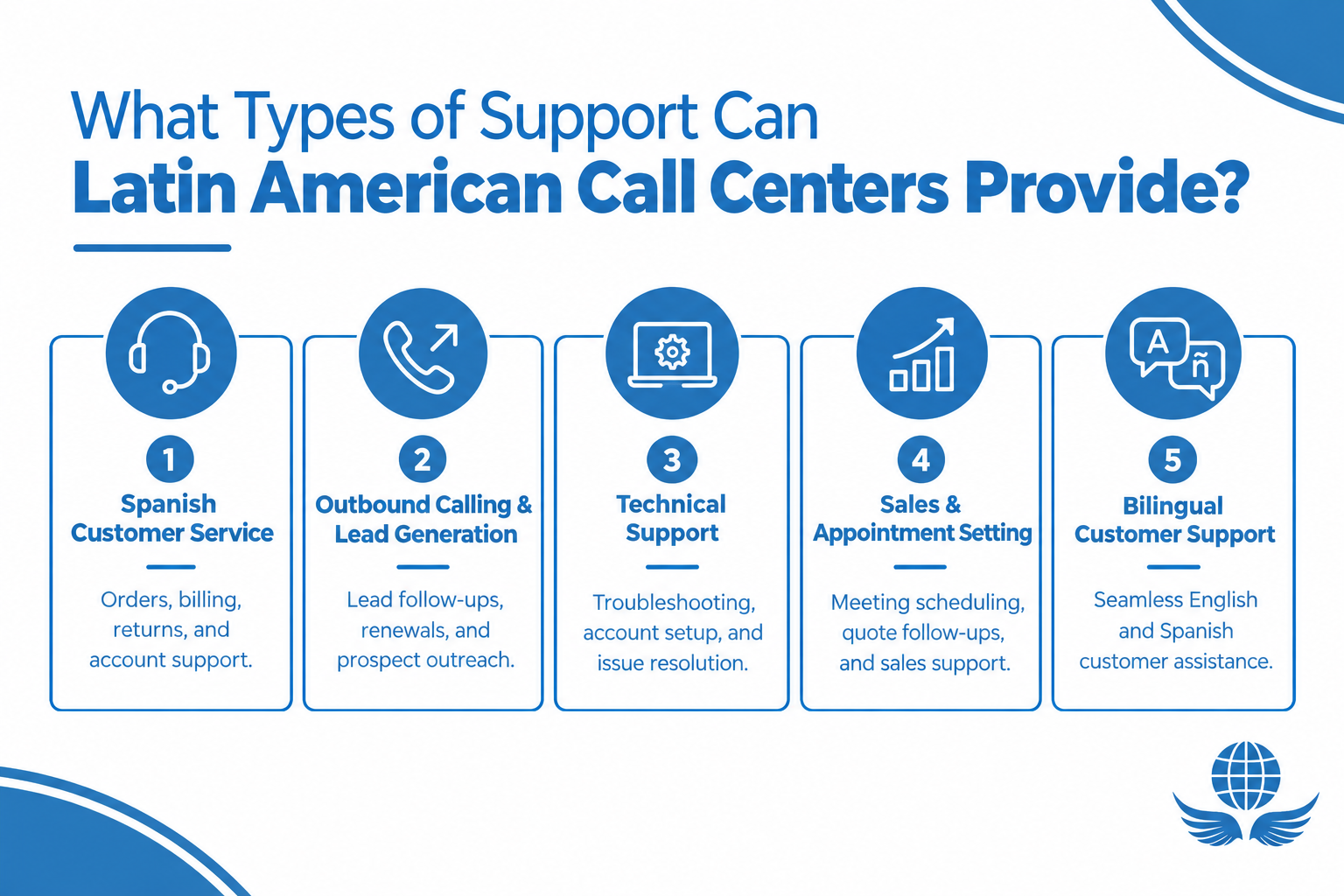
Inbound Spanish Customer Service
Inbound Spanish customer service agents manage orders, billing, returns, and accounts via phone, chat, email, and messaging.
Outbound Calling & Lead Generation
Agents follow up on leads and renewals. As always with U.S. calling, read through scripts and consent records.
Technical Support and Troubleshooting
Agents reset accounts, set up systems, and log faults. We document all cases before escalating them to our technical support teams.
Sales, Appointment Setting, and Follow-Ups
Agents schedule meetings, verify visits, and follow up on open quotes.
Bilingual Customer Support
Our bilingual customer service teams answer English and Spanish callers in one queue, with one shared history.
Nearshore Latin American Support vs. U.S. Based Call Centers
| Factor | Nearshore Latin America | U.S. Based |
|---|---|---|
| Cost | Often lower wages | Higher wages |
| Spanish skills | Native speakers | Harder to hire at scale |
| Time zones | Same or close | Same |
| Hiring speed | Large talent pools | Tight labour market |
Cost and Staffing
Hiring employees in the U.S. is expensive and takes time. The federal government also anticipates a 5% decline in U.S. customer service roles from 2025 to 2035, which could reduce local supply.
Language Skills and Customer Experience
Native Spanish support feels natural and helps build trust, even on the toughest calls.
Time Zone Compatibility
Both options cover U.S. hours. Nearshore teams cost less
Management, Quality, and Service Consistency
It’s easier to visit U.S. teams. To achieve that level of control, nearshore teams require clear reporting, live dashboards, and regular reviews.
What Should U.S. Businesses Consider Before Outsourcing to Latin America?
Check these five areas before you choose a Spanish BPO or any Latin American call center.
Spanish Fluency and Regional Language Differences
Regional Spanish varies in words and accents. Match agents with your callers. Callers from Puerto Rico might not sound like people from Mexico.
Agent Training and Industry Knowledge
Ask about their training period and how they evaluate agents before making live calls.
Data Security and Customer Privacy
Regulations vary from country to country. Mexico’s new data protection law took effect on March 21, 2025, including provisions on transferring data to other countries. Request PCI DSS compliance for payments.
Service Quality and Performance Monitoring
Request call recordings, quality scores, and live dashboards. Report English and Spanish results separately.
Provider Experience and Scalability
Choose a partner that knows your field and can grow with you.
Is a Latin American Support Team Right for Your Business?
It often is if you have steady Spanish volume and need U.S. hours. If your volume is very small, it may not be.
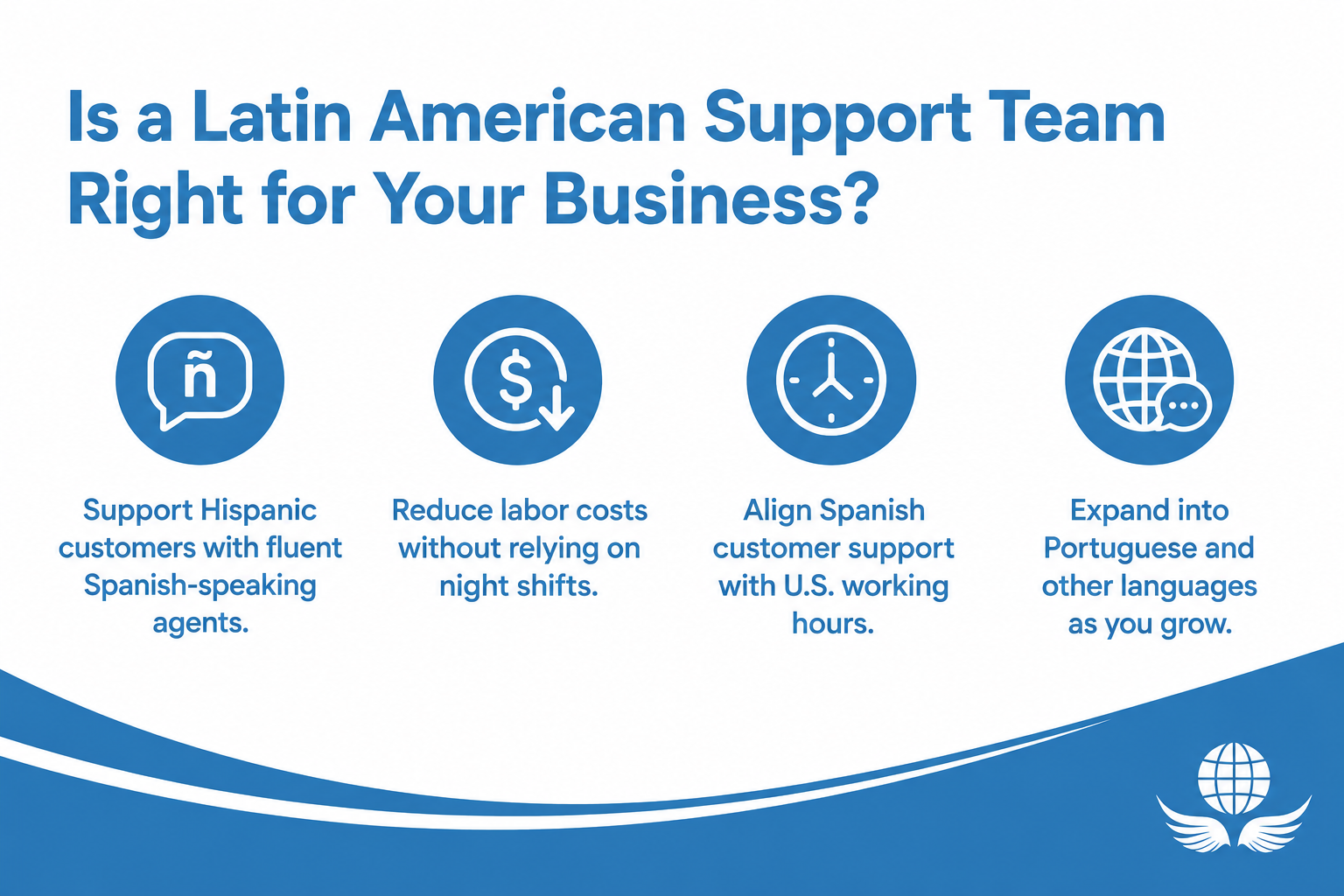
Businesses Serving Spanish-Speaking Customers
Spanish-speaking nearshore agents are best suited for retail, health, finance, and utility brands that boast Hispanic buyers.
Companies Looking to Manage Support Costs
LATAM call center outsourcing reduces labour costs, but not by shifting support to night shifts.
Businesses Requiring U.S. Business Hours Coverage
A Spanish call center nearshore team is easily available during the day if callers call then.
Companies Expanding Their Customer Support Operations
Newshore can provide Spanish customer support and then move to Portuguese, all under the same contract, for growing brands.
How Agents Republic Supports U.S. Businesses With Multilingual Customer Service
Agents Republic is a Canadian company. Our Spanish call center services connect agents to your Spanish callers. We support you via phone, email, chat, and messaging.
Dedicated Spanish teams are priced by the agent hourly rate, times your coverage hours, plus a fixed monthly supervision fee. Our shared 24/7 answering service is English only. Call +1 (604) 210-8100 for a cost plan.
Final Thoughts
A nearshore Spanish call center gives U.S. businesses native call center agents, shared hours, and lower costs. Choose a Spanish BPO that uses the right dialects, strong data protection, and transparent reporting.
Ready to plan your Spanish team? Call +1 (604) 210-8100 today.
Frequently Asked Questions (FAQs)
Why do U.S. businesses outsource call center services to Latin America?
They get native Spanish agents, working hours that match their own, and much lower labour costs. Many agents also have a strong command of English so that a single team can be fluent in both languages. Spanish nearshore outsourcing also makes training and daily management easier because U.S. managers and nearshore agents share the same hours.
Which Latin American country is popular for nearshore call center support?
Usually, companies choose Mexico or Colombia. Mexico provides scale and proximity to the U.S.; Colombia has a clear, neutral accent. Other popular Central American destinations include Costa Rica, Guatemala, and El Salvador. Each has its own merits, and the best option depends on who you’re calling, how much you’re willing to spend, and which Spanish dialects you want.
Are Latin American call centers more affordable than U.S. call centers?
Often, yes. Wages across the region are often lower than U.S. wages, where the median for customer service workers was $21.53 an hour in 2025. End costs depend on skills, hours, and channels. Often, dedicated teams cost coverage hours plus a supervision fee, so get a cost plan.
Can Latin American agents provide native or fluent Spanish support?
Yes. In most of the area, Spanish is the native language, and agents can speak it. Many also speak English fluently. Match agents to the dialects your callers use, since word choice and accent can differ. A good provider will provide sample calls for you to listen to before launching.
Do Latin American call centers operate during U.S. business hours?
Yes. Most are located in or close to U.S. time zones. Colombia is in the same time zone as EST, and Mexico City is in the same time zone as CST. Standard shifts include the U.S. business day, and you can easily add evening or weekend shifts as needed. That means that the offshore teams don’t have to do any overnight work.
Can a nearshore call center provide both English and Spanish support?
Yes. A bilingual nearshore call center has representatives who speak both languages in one queue, typically acquired through LATAM call center outsourcing. This is appropriate for callers who speak multiple languages during a call. Later, nearshore Spanish customer support teams can add other languages such as Portuguese. Ask how the provider tests English skills.[/vc_column_text][/vc_column][/vc_row]

