
Key Takeaways
- Korean buyers expect polite speech, fast replies and a quick path to a real person.
- Like phone and email, KakaoTalk is widely used in Korea.
- Canada has its own Korean buyers, with more than 218,000 people of Korean origin.
- Seoul is 16 or 17 hours ahead of Vancouver, which means that Canadian brands require a team that works Korean hours.
- A dedicated team provides Korean support and is not billed on a minute-by-minute basis.
Can your support team answer in Korean? For many Canadian firms, it now matters. Canada’s exports and imports of goods with South Korea totalled $25 billion in 2025. That makes South Korea Canada’s seventh-largest trade partner.
Those sales are correlated with support tickets. Korean customer service is where many foreign brands win or lose trust. In Korea, people compare brands. They notice quickly when support feels slow or poorly translated.
This guide shows what these buyers expect and how to serve them well from Canada.
Planning Korean coverage? Get a quote for your channels and hours.
What Makes Korean Customer Service Different?
It varies in three aspects: language, speed, and channel. First, the Korean language has several levels of politeness built into its grammar. Agents must choose the right level; incorrect politeness can sound rude, even when the facts are correct.
Second, customers expect fast replies. In chat and messaging, many people expect a response within minutes, not hours.
Third, the primary channel isn’t the phone; it’s a messaging app. In Korea, people use KakaoTalk almost daily, and brands are expected to be there as well. They also like detailed instructions, a sincere apology, and prompt problem resolution.
Who Are Your Korean Callers?
Korean callers fall into four groups. All have different language requirements and time zones.
Customers in South Korea
In South Korea, messaging is the most used channel. KakaoTalk’s monthly active users (MAU) in Korea were 49.5 million in the same period, out of a population of around 52 million.
They also rate foreign brands on their service setup. A 2025 Seoul survey revealed that the lack of customer service infrastructure is one of the issues consumers have with overseas shopping platforms. A local help centre in Korean and clear refund terms make a real difference.
Korean Customers in Canada
There are many Koreans in Canada. Over 218,000 Canadians identify as being Korean. South Korea is also a leading provider of students to our country.
Many Korean Canadians switch between Korean and English. Newer arrivals and students often want Korean, especially for billing, health, or legal issues. As a result, many businesses need bilingual, Korean-speaking customer service in Canada.
How Can Businesses Deliver Better Korean Customer Support?
Translation alone isn’t enough for businesses serving Korean customers. They need Korean language support, communication style, and customer expectations.
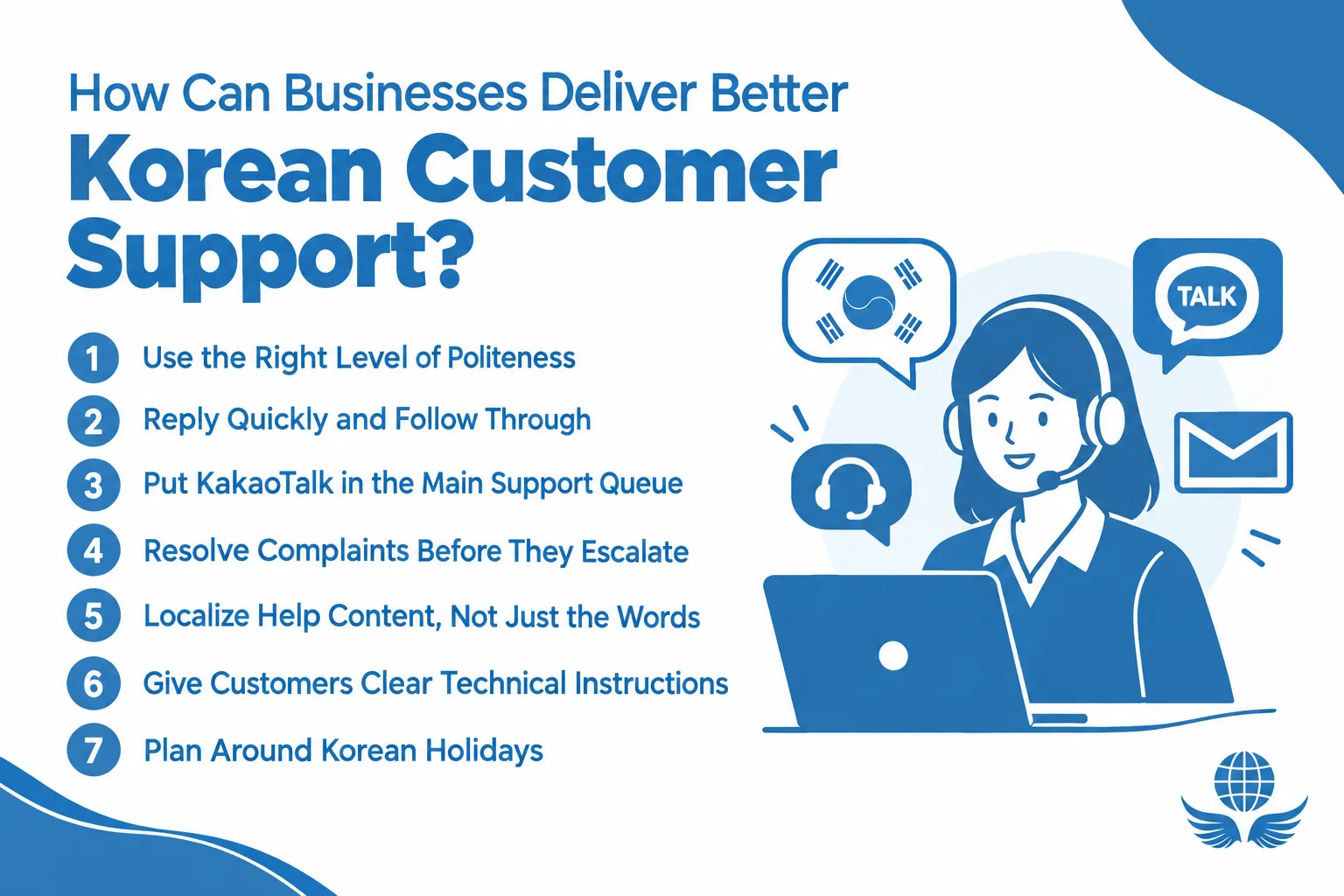
Whether it’s adopting an appropriate level of politeness, handling KakaoTalk messages or arranging for holidays, these seven practices can help businesses provide better service to Koreans.
1. Use the Right Level of Politeness
Korean has many degrees of formality and politeness, which affect word choice and verb endings. Polite, respectful language is essential in customer service.
Using language that is too casual can sound unprofessional, while overly formal wording may feel unnatural. Agents need to adapt their tone and language to the context while remaining respectful.
Cultural fluency also means knowing when to apologize, thank the customer, or acknowledge a concern. A direct English response may not be as respectful to a Korean audience.
Agents should be trained to
- Properly greet and use polite language.
- Keep the same degree of formality throughout.
- Avoid informal or colloquial expressions.
- Appropriately acknowledge the inconvenience caused by the business.
- Describe solutions respectfully, especially when addressing complaints.
Native Korean speakers can provide more natural and appropriate customer responses.
2. Reply Quickly and Follow Through
Responses are important, but it is also crucial that customers get the right answers and transparent updates. If it will take time to resolve, agents should tell the customer what is happening and when they can expect to hear back.
Set response-time goals for phone, chat, and messaging. Set different standards for first responses, case updates and escalations.
If the issue isn’t solved immediately, agents should:
- Empathize with the customer’s concern.
- Describe what to check.
- Give an estimated date for the next update.
- Keep up the promised time.
- Verify the problem is fixed.
A quick reply followed by silence can frustrate customers. Regular updates can help build trust, even if it takes longer than expected.
3. Put KakaoTalk in the Main Support Queue
KakaoTalk is a major communication channel in South Korea. Businesses should incorporate it into their broader support system and handle it within it, not in a separate inbox. That is real omnichannel support.
When messages are disconnected from phone, email, and chat, agents may miss important details or ask customers to repeat themselves.
An integrated support queue can bring together:
- KakaoTalk messages
- Phone calls
- Email enquiries
- Website live chat
- Social media messages
Our Korean call centre services can support businesses looking to coordinate KakaoTalk, voice, chat, and email through their customer service tools.
4. Resolve Complaints Before They Escalate
An effective complaint-handling process helps businesses resolve issues before they affect the customer relationship. Agents should listen to the customer, take the problem seriously, and try to find a practical solution.

A simple process includes:
- Acknowledge the concern: Respond by letting the customer know you have heard what they are saying.
- Review the details: Examine the order details and previous interactions.
- State the answer: Describe the options and future actions.
- Follow up: Ensure the planned action has been implemented.
Agents should know when they can grant a refund or replacement and when a supervisor should review the case. Good customer communication at this stage protects your name.
5. Localize Help Content, Not Just the Words
Language localisation means making an entire support experience available to Korean customers. Copying English text word for word can create a confusing document for customers, with unclear policies and terminology.
Check everything for the customer before launching Korean support.
| Content | What to localize |
|---|---|
| Help articles | Clear Korean instructions |
| Chat and email templates | Natural, polite responses |
| Phone menus | Clear language and routing options |
| Refund policies | Conditions, timelines, and exceptions |
| Payment information | Familiar terms and clear explanations |
| Product guides | Localized terminology and examples |
Display prices in Korean won where relevant, and clearly explain payment, refund, and cancellation terms.
6. Give Customers Clear Technical Instructions
Technical support becomes frustrating when instructions are long or difficult to follow. Help for Korean customers should include clear, practical steps for app, game, device, and online service issues.
Agents should:
- Divide instructions into numbered steps.
- Use the names customers see on their screens.
- Avoid using long, complex sentences.
- Provide screenshots when explaining what to do.
- Describe technical terms in simple words.
- Check if the solution is correct.
If the issue continues, agents should collect the necessary details and escalate it rather than asking customers to repeat steps that have already failed.
Our technical support staff resolves first- and second-line issues, explains the troubleshooting procedure in Korean, and guides customers through the process.
7. Plan Around Korean Holidays
Base staffing needs not only on average contact volumes but also on seasonal demand. For businesses doing business with South Korea, the Lunar New Year holiday period (Seollal) and the fall harvest holiday period (Chuseok) are significant.
Depending on the industry, customers may ask about delivery times, booking travel, cancellations, service availability, etc.
Businesses should take the following steps before major holidays:
- Review previous contact volumes.
- Predict customer needs through all support channels.
- Rotate other staff as necessary.
- Verify agent working hours and backup.
- Inform customers of any scheduled downtime or delays.
- Prepare answers for common holiday questions.
Compare actual and predicted demand after each holiday. Analysing response times, backlogs, and customer feedback will help optimize staffing in the upcoming peak period.
Our guide on scaling customer support explains how businesses can prepare for changing demand while maintaining service quality.
How Can a Canadian Business Cover Korean Business Hours?
DST is not enabled in Korea. That means that Seoul is 16 or 17 hours ahead of Vancouver and 13 or 14 hours ahead of Toronto, depending on the season. When it is 9 a.m. in Seoul, it is late afternoon or evening of the previous day in Canada.
| Staffing Model | Best For | Main Drawback |
|---|---|---|
| In-house team in Canada | Korean Canadians during Canadian hours | Cannot cover Korean business hours |
| Direct hires in South Korea | Large, long-term programs | Local hiring, payroll and legal setup |
| Outsourced dedicated Korean team | Growing programs in Canada and Korea | Needs a clear handover of product knowledge |
| Shared English answering service | Simple English calls only | No Korean coverage |
How Does Agents Republic Provide Korean Support Services?
Agents Republic is a Canadian company. We have offices in Vancouver and Budapest, and a sales office in Toronto. Our call centre services support clients in Canada, the USA, and Western Europe.
Native agents in our Korean support services work Korean business hours. One program involved a mobile game studio that needed support from day one in the U.S., Korea, and Japan.
Our staff dealt with every payment challenge and account recovery in every language. The client said we met and exceeded all its KPIs. Japanese, Mandarin and Cantonese programs may be added to the Korean programs under a single contract.
Check out our Japanese call centre services, too. We are PCI DSS certified and GDPR compliant, with a BBB A+ rating.
Final Thoughts
Good Korean customer service is polite, efficient and available on the platforms that customers use. It communicates at the appropriate level, responds promptly and resolves issues before they turn into reviews.
For Canadian companies, it also means covering Korean hours and offering bilingual support at home. If these basics are right, buyers will have a reason to stay for the Korean customer experience.
Interested in serving Korean customers in Canada and South Korea? Call +1 (604) 210-8100 to plan your Korean team today.
Frequently Asked Questions (FAQs)
Which level of politeness should agents use with Korean customers?
Agents should use formal and polite language in all interactions with customers. These levels show respect and are expected in business.
Even the right answer, when offered in casual speech, can come across as rude. Native speakers switch between these levels easily, while learners mix them up. That’s why a native agent will provide the safest outcomes.
Do businesses need to support KakaoTalk?
Yes, for those in South Korea. KakaoTalk is used by most Koreans. Most use KakaoTalk for quick questions and updates.
A brand that offers only phone and email misses much of this demand. The ideal setup is to place KakaoTalk in the same queue as the other channels and maintain a single customer history.
Could a team serve Korean customers in Canada and South Korea?
Yes, as long as the team includes both sets of hours and the languages covered. Customers in Korea need support during Korea Standard Time, mostly in Korean.
Korean Canadians need support in Korean and English. Bilingual staff with shifts that meet each market do a great job with both groups without transfers.
What would the appropriate business hours be for a Canadian company dealing with Korean customers?
At minimum, cover Korean business hours, roughly 9 a.m. to 6 p.m. in Seoul. That’s late afternoon and evening the day before in Vancouver and even later in Toronto.
Plan your shifts to match. Many brands also include nights and weekends in Korea, when shopping and messaging tend to be the highest.
Can machine translation handle Korean support?
Machine translation can help agents read messages faster. It struggles with politeness, tone, and context, which are crucial in Korean.
An inappropriate level of politeness may come across as cold or rude. Native agents should provide live answers; translation tools should be used as a background aid.

