
Introduction
As of September 30, 2025, about 258.5 million phone numbers were registered on the US National Do Not Call Registry (source: FTC National Do Not Call Registry Data Book, FY2025). Call center compliance is how a business respects that choice, along with every other rule on consent, privacy and payments.
For businesses in Canada and the United States, these rules overlap and keep changing. This guide shows which laws apply and how to build a program that stands up to an audit.
Looking to plan an outsourced program? Request a quote.
Key Takeaways
- Call center compliance covers consent, privacy, call recording, payments and sales calls.
- Canadian programs must follow PIPEDA, CRTC telemarketing rules, CASL and provincial privacy laws.
- US programs may need to follow the TCPA, the Telemarketing Sales Rule, PCI DSS, and HIPAA or the CCPA, depending on their channels and data.
- Training, scripts and regular checks turn written rules into daily habits.
- Outsourcing does not remove responsibility, and your vendor must prove its controls.
What Is Call Center Compliance?
Call center compliance means following every law and regulation that governs how a call center contacts customers and handles their information. It covers who can be contacted, when, what agents must say, and how personal data is collected, recorded and protected.
The rules follow your customer’s location, not your agent’s. A Vancouver team calling people in California must follow US federal and California law. A team serving Canadians must follow Canadian law.
A strong program covers four areas: sales-call rules, privacy rules, call-recording rules and payment-security rules. Each area needs written policies and tools with proven results. Violations can lead to fines, lawsuits, lost clients and even the loss of card-payment privileges. The goal is simple: every call should be legal, documented and in line with the client’s requirements.
Definition of Call Center Compliance
Call center compliance is the set of policies, controls and records that keep a call center within the law and within its clients’ rules.
Why Compliance Matters in Contact Center Operations
One agent can create hundreds of violations in a single shift. Effective controls stop small mistakes from spiralling out of control.
Compliance vs. Quality Assurance vs. Agent Adherence
| Term | Main Question | Example |
|---|---|---|
| Compliance | Did we follow the law? | Recording disclosure given |
| Quality assurance | Was the service good? | Issue solved politely |
| Agent adherence | Did the agent follow the plan? | Script and schedule followed |
Why Is Call Center Regulatory Compliance Important?
Call center regulatory compliance protects your customers, your brand and your budget.
Avoiding Legal Penalties and Financial Losses
Fines are charged per call or text. One faulty call list can lead to thousands of violations.
Protecting Customer Data and Privacy
Call centers handle account and card details every day. IBM’s Cost of a Data Breach Report 2025 puts the global average cost of a breach at USD 4.44 million.
Building Customer Trust and Brand Reputation
When customers feel their choices are respected, they trust the brand. When they don’t, complaints spread quickly online.
Reducing Operational and Third-Party Risks
Clear rules help you avoid rework, disputes and surprises from vendors.
Key Call Center Compliance Standards, Laws, and Regulations
These call center compliance standards matter most for programs serving North American and European customers.
| Law or Standard | Applies When | Core Rule |
|---|---|---|
| TCPA | Autodialed, prerecorded or AI-voice calls and texts in the US | Consent and opt-out |
| Telemarketing Sales Rule | US sales calls | Do Not Call, disclosures, records |
| PCI DSS | Card payments | Protect card data |
| HIPAA | US health information | Safeguards and business associate agreements |
| CCPA/CPRA | California residents’ data | Privacy rights and contracts |
| PIPEDA | Commercial activity in Canada | Consent and safeguards |
| CRTC rules and CASL | Calls and messages to Canadians | Do Not Call, hours, consent |
| GDPR | People in the EU | Lawful basis and data rights |
US Call Center Compliance Regulations
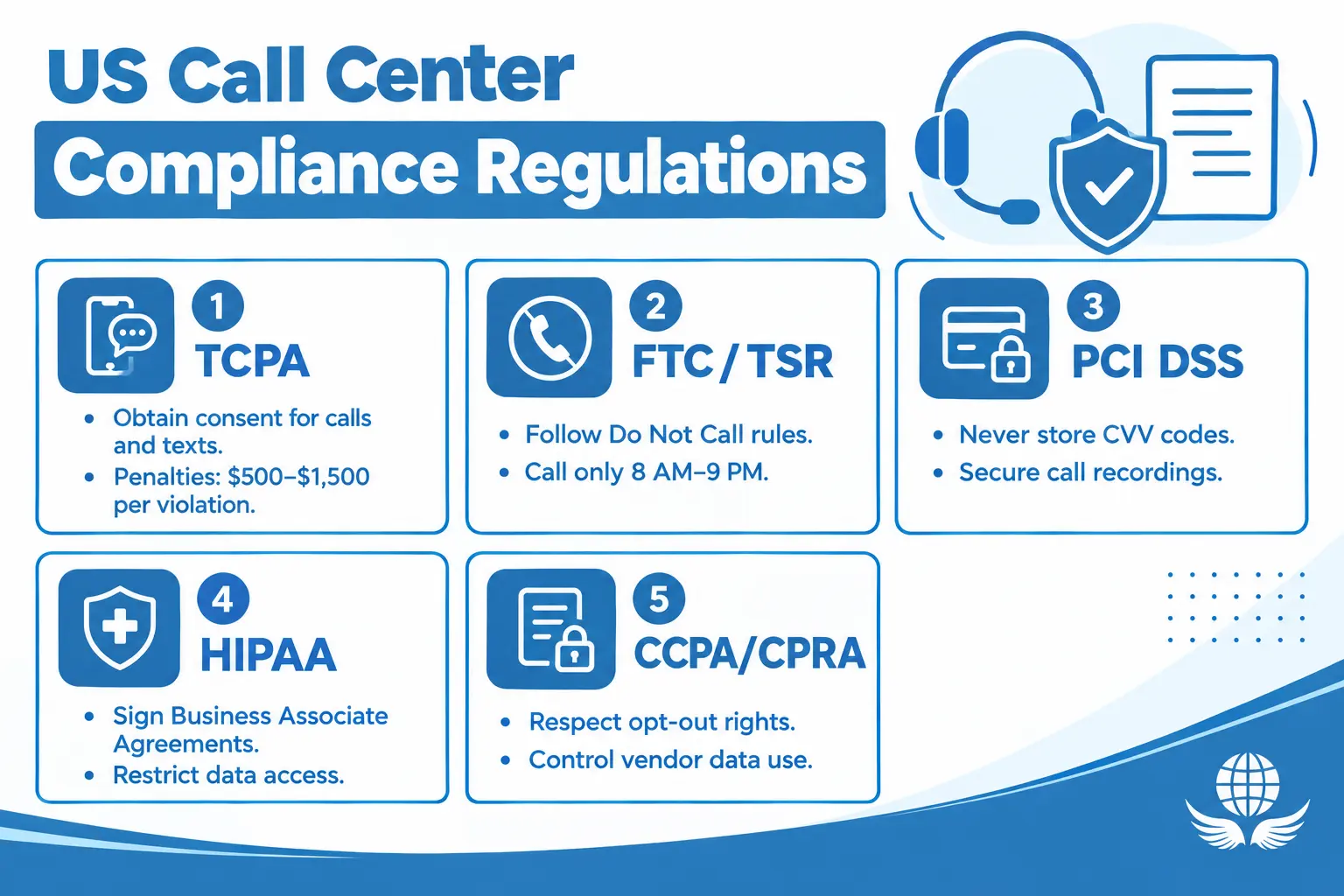
Telephone Consumer Protection Act (TCPA)
The Telephone Consumer Protection Act (TCPA) limits robocalls and texts. Telemarketing calls or texts sent with an autodialer or an artificial or prerecorded voice, including AI-generated voices, need prior express written consent. Informational autodialed calls need prior express consent, which does not have to be written.
Consumers can revoke consent by any reasonable means. Under the FCC’s October 2026 Report and Order, a caller may instead designate one exclusive opt-out method, if it clearly discloses that method. An opt-out from a sales call or text covers all future sales calls and texts from that caller. An opt-out from an informational message covers only that category of messages. Either way, opt-outs must be honoured within 10 business days.
Consumers can sue for USD 500 per violation, or up to USD 1,500 if the violation is wilful or knowing.
Federal Trade Commission (FTC) and Telemarketing Sales Rule
The Federal Trade Commission (FTC) enforces the Telemarketing Sales Rule. Sellers and telemarketers must scrub their call lists against the National Do Not Call Registry at least every 31 days.
Calls are allowed only between 8 a.m. and 9 p.m. in the called person’s local time, and they must not be deceptive. Civil penalties can reach USD 53,088 per violation.
Payment Card Industry Data Security Standard (PCI DSS)
The Payment Card Industry Data Security Standard (PCI DSS) applies to every team that accepts card payments. PCI DSS is not a law, but card brands and banks require it by contract. Never store card verification codes after a payment is authorized, even in encrypted form. This includes call recordings. The current version, PCI DSS v4.0.1, is published by the PCI Security Standards Council.
Health Insurance Portability and Accountability Act (HIPAA)
The Health Insurance Portability and Accountability Act (HIPAA) protects US health data. A call center that handles protected health information (PHI) for a clinic is usually a business associate. It must sign a business associate agreement (BAA) and limit access to PHI.
California Consumer Privacy Act (CCPA/CPRA)
The California Consumer Privacy Act (CCPA) applies to for-profit businesses that meet one of three thresholds, such as annual gross revenue over USD 26,625,000. Californians can see, correct and delete their data, and opt out of its sale or sharing. Vendors must be bound by a contract that limits how they use the data.
State-Specific Call Recording and Privacy Laws
Most states allow recording with the consent of one party. About a dozen states, including California, Florida and Pennsylvania, require every party to consent. The safe practice is to tell every caller that the call is recorded.
Canadian Call Center Compliance Regulations
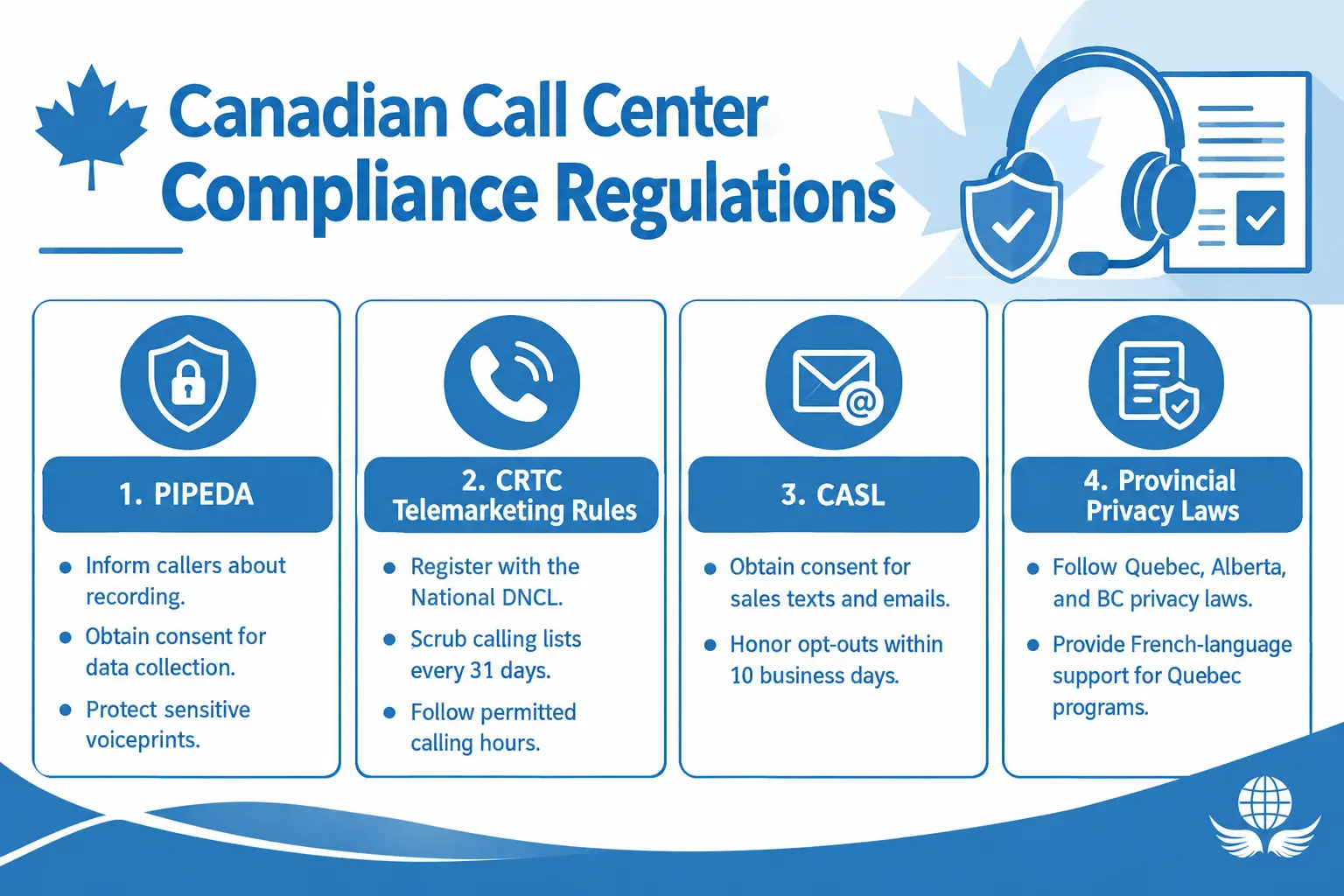
Personal Information Protection and Electronic Documents Act (PIPEDA)
PIPEDA is Canada’s federal private-sector privacy law. Under guidance from the Office of the Privacy Commissioner of Canada (OPC), you must tell callers that the call is recorded, explain why, and obtain their consent. This applies whether the customer or the business placed the call.
On October 8, 2026, the OPC updated its call-recording guidance. Voiceprints are now treated as sensitive biometric information, and businesses that contract out to call centres must make sure those third parties follow PIPEDA.
CRTC Telemarketing Rules and National Do Not Call List
Telemarketers must register with the National DNCL and scrub their lists at least every 31 days. Telemarketing calls may be made only from 9 a.m. to 9:30 p.m. on weekdays and 10 a.m. to 6 p.m. on weekends, in the called person’s local time. Corporations can be fined up to CAD 15,000 per violation. Our guide to inbound vs. outbound call center services explains how these rules apply in practice.
Canada’s Anti-Spam Legislation (CASL)
CASL applies to commercial electronic messages, such as marketing emails and texts. Each message needs consent, your contact details and a working unsubscribe mechanism. The mechanism must stay active for 60 days after sending, and unsubscribe requests must be honoured within 10 business days. Penalties can reach CAD 10 million per violation for businesses.
Provincial Privacy Requirements
Quebec, Alberta and British Columbia each have their own private-sector privacy laws. Penal fines under Quebec’s Law 25 can reach CAD 25 million or 4% of worldwide turnover, whichever is greater. Quebec programs also need French call center services, because the Charter of the French Language gives customers the right to be served in French.
When Does the General Data Protection Regulation (GDPR) Apply?
The General Data Protection Regulation (GDPR) applies if you offer goods or services to people in the EU, or monitor their behaviour, even when your team is in Canada. You need a lawful basis for each use of personal data.
You must respect access and deletion requests, and you must protect personal data sent outside the EU. Canada has EU adequacy status for organizations covered by PIPEDA, which makes transfers to Canada simpler. Fines can reach EUR 20 million or 4% of global annual turnover, whichever is higher. If you serve EU customers, you may also need language support such as German call center services or Spanish call center services.
Essential Call Center Compliance Requirements and Best Practices
These practices turn the law into daily habits.
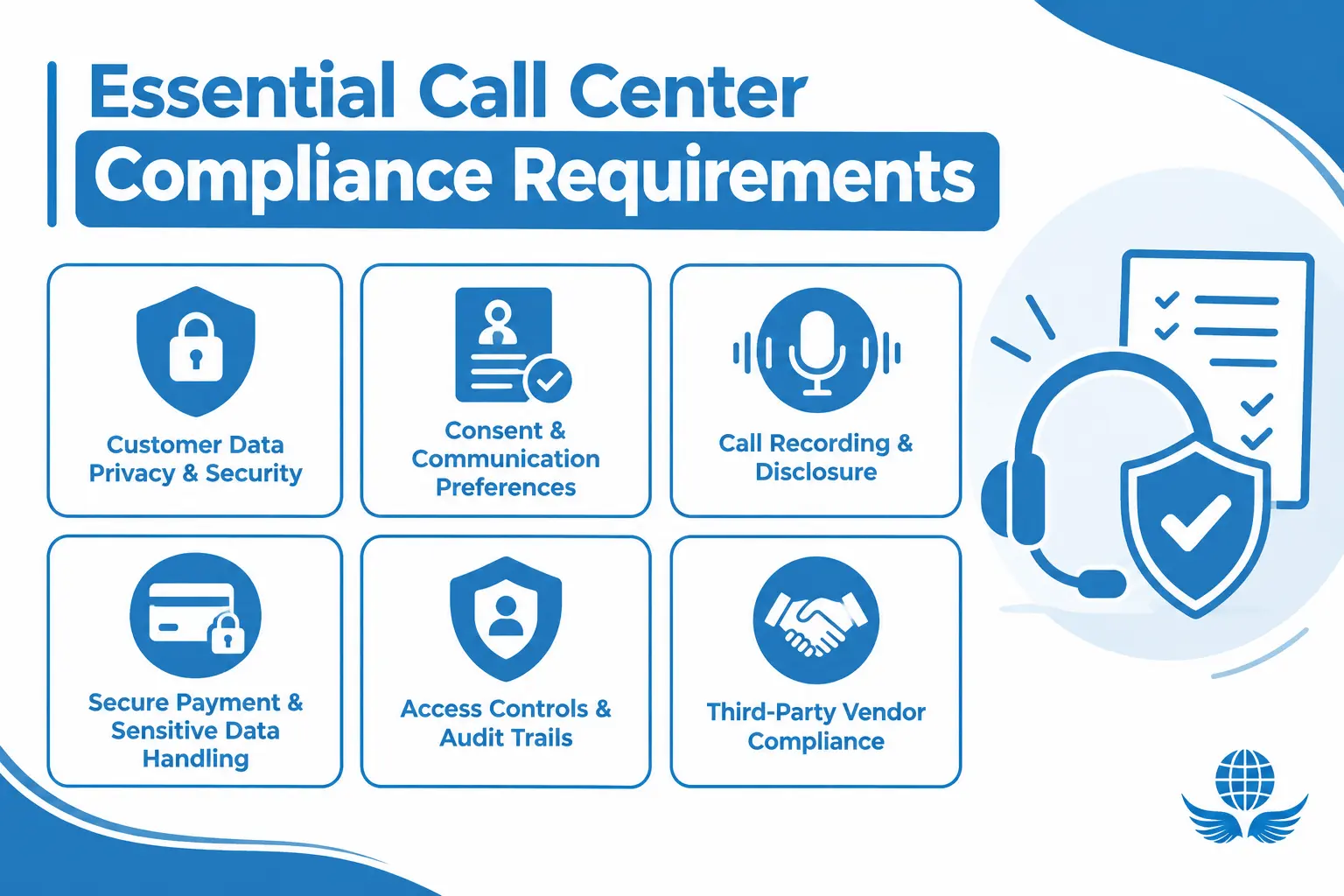
Customer Data Privacy and Security
Collect only the data each task needs. Encrypt it, restrict access to it, and delete it on a set schedule. Remote agents need secure, company-controlled devices and networks.
Customer Consent and Communication Preferences
Record when, how and for what purpose each customer gave consent. Honour opt-outs on every channel. Consent for one channel doesn’t automatically cover another, so check the wording of each consent.
Call Recording for Compliance and Disclosure
Play a recording notice at the start of every call and explain why the call is recorded. Limit who can listen to recordings, and delete them at the end of your retention period.
Contact Centre Script Adherence and Mandatory Disclosures
Approved scripts make sure agents never miss a required line. Contact centre script adherence covers ID checks, recording notices, pricing and escalation steps. Agents can adapt their tone, but not the required wording.
Secure Payment Processing and Sensitive Data Handling
Use automatic pause-and-resume so the recording stops while card details are given. Better still, use DTMF masking, so customers key in card numbers and neither the agent nor the recording hears them. Our order-taking services use PCI DSS-compliant SecurePhone payments.
Access Controls, Documentation, and Audit Trails
Grant access by role. Log every view, change and export, and keep incident records, because auditors ask for proof.
Third-Party Vendor and Outsourced Call Center Compliance
In Canada, you remain accountable for personal information you send to a third party for processing. The same idea applies under the CCPA, HIPAA and GDPR. Check each vendor’s certifications and contract terms. Our guide to outsourcing call centers explains how to set up shared responsibilities.
Want a partner with these controls built in? Call +1 (604) 210-8100.
Call Center Compliance Training and Agent Adherence
What Is Adherence in a Call Center?
Adherence in a call center is how closely agents follow their schedule, script and call steps.
Building an Effective Call Center Compliance Training Program
Train agents on each client’s rules with real call examples, and give them short tests before they take live calls. At Agents Republic, every new agent passes a background check, a systems test and client-specific training, then a final test before sign-off. Read more about our [recruitment process].
Improving Contact Centre Script Adherence
Write each required notice in plain words and explain why it exists. Agents follow rules they understand.
Measuring Agent Adherence and Training Effectiveness
Track disclosure completion rates, test scores and repeat errors for each agent. We keep one team lead for every 17 agents, and our [agent / team lead] turnover is 12%.
Refresher Training and Policy Updates
Run refresher training at least once a year, and again whenever a law, client policy or script changes.
Compliance Monitoring, Audits, and Performance Measurement
The compliance monitoring process runs in five steps: speech analytics, alerts, human review, coaching and audit logs.
Manual Call Reviews and Compliance Scorecards
Team leads score a sample of calls every week. Each required notice is a pass/fail item on the scorecard.
Automated Compliance Monitoring and Speech Analytics
Speech analytics scans every call for missed disclosures and high-risk phrases, then flags them for human review.
Key Compliance Metrics and KPIs
- Disclosure compliance rate (percentage of calls with every required notice)
- Do Not Call violations per 1,000 calls
- Consent records found on audit
- Time to honour opt-out requests
- Open incidents and time to close
Compliance Audits, Incident Reporting, and Corrective Actions
Run compliance audits at least quarterly. Record every incident, fix the root cause, and document the change.
Call Center Compliance Checklist
This call centre compliance checklist is a working tool to use on an ongoing basis, not a one-time review.
Regulatory and Legal Requirements
- Map every applicable law by customer location and industry
- Register with the National DNCL, and subscribe to the US National Do Not Call Registry and state lists if you call US numbers
- Review legal requirements at least once a quarter
Customer Consent and Call Recording
- Keep consent records with the date, source and purpose
- Play a recording notice on every call
- Honour opt-outs within legal deadlines
Customer Data Privacy and Security
- Collect only the data each task needs
- Encrypt data and apply role-based access
- Pause or mask recordings during payments
Agent Training and Script Adherence
- Train every agent before their first live call
- Lock approved scripts so required wording can’t be edited
- Test agents and track the results
Monitoring, Audits and Documentation
- Review a sample of calls every week
- Maintain audit trails and incident logs
- Document every corrective action
Vendor Risk and Incident Response
- Check each vendor’s proof of security and contract terms
- Set breach-notification steps, deadlines and contacts (for example, 72 hours under GDPR)
- Test the incident response plan at least once a year
Call Center Compliance Solutions: Features to Look For
The most effective call centre compliance solutions combine software with trained staff.
Automated Compliance Monitoring and Alerts
Get real-time alerts when an agent misses a required disclosure or dials a blocked number.
Secure Call Recording and Payment Data Masking
Recordings should be encrypted, access-controlled and able to redact card details.
Script Management, Consent Tracking, Audit Reporting
Scripts need version control, and consent records and audit reports should be easy to export.
How to Evaluate Compliance Software and Service Providers
Ask for a PCI DSS Attestation of Compliance (AOC), a SOC 2 Type II report and sample contract clauses. Our guide to managing offshore support risks and our RFI questions for call center outsourcing help you compare providers.
How to Build a Call Center Compliance Program
Step 1: Identify Applicable Regulations and Risks
Map your customer locations, channels, data types and payment methods to the laws above.
Step 2: Document Policies, Scripts, and Procedures
Write policies, approved scripts and procedures, and assign an owner to each.
Step 3: Train Agents and Assign Accountability
Train all agents and supervisors, and name one person who is accountable for the program.
Step 4: Establish Monitoring and Compliance Controls
Set up recording controls, consent tracking, access limits and call scoring.
Step 5: Review, Audit, and Continuously Improve
Audit regularly, document incidents, and update policies as laws change.
Conclusion: Maintaining Long-Term Call Center Compliance
Compliance never stops. In October 2026 alone, the OPC updated its call-recording guidance and the FCC revised its TCPA opt-out rules, which shows how fast the rules change. Good programs have clear rules, trained agents, frequent reviews and secure systems.
Agents Republic is a Vancouver-based call center outsourcing company. We are PCI DSS certified, GDPR compliant and BBB A+ rated, and our 24/7 answering service plans support PIPEDA and CCPA compliance.
Call us at +1 (604) 210-8100 or contact our team to build a compliant support program today.
Legal Disclaimer
This article is for general information only and is not legal advice. Laws and regulator guidance change often, and requirements depend on your location, industry and channels. Agents Republic does not guarantee that following this guide will make your business compliant. Please consult qualified legal counsel about your specific obligations.
Frequently Asked Questions
What Is Call Center Compliance?
Call center compliance means following every law and regulation that governs how a call center deals with customers and manages their information. This includes consent, calling hours, call recording, card security and privacy rights. It applies to both in-house teams and outsourced partners, and it depends on where your customers live, not where your agents are based.
What Regulations Govern Call Centers in the US and Canada?
In the US, key rules include the TCPA, the Telemarketing Sales Rule, PCI DSS, HIPAA and state laws such as the CCPA. In Canada, key rules include PIPEDA, the Canadian Radio-television and Telecommunications Commission (CRTC) telemarketing rules, Canada’s Anti-Spam Legislation (CASL) and provincial laws such as Quebec’s Law 25. GDPR also applies when you serve people in the EU.
What Are the Most Important Call Center Compliance Standards?
For payments, PCI DSS matters most, because it protects card data on calls and in recordings. Personal information is covered by privacy laws such as PIPEDA, the CCPA and GDPR. Outbound calls are covered by telemarketing rules such as the TCPA, the Telemarketing Sales Rule and CRTC rules. The right mix depends on your customers and channels.
How Can Call Centers Improve Agent Compliance and Script Adherence?
Use short, approved scripts with the required wording clearly marked. Explain why each rule exists, and test agents on it before live calls. Score a sample of calls every week, and use speech analytics to review all calls where possible. Give feedback quickly, and recertify agents who make the same error twice.
Are Call Centers Required to Disclose Call Recording?
In Canada, yes. PIPEDA guidance says you should tell callers you are recording, explain the purpose and obtain their consent. In the US, some states require every party to consent, while others require only one. For cross-border programs, the simplest approach is to announce the recording and its purpose at the start of every call.
How Often Should Call Center Compliance Training Be Conducted?
Train every agent before their first live call, and run refresher training at least once a year. Add short updates whenever laws, client policies or scripts change. Give agents who fail a call review targeted coaching right away. Keep training records, because auditors often ask for proof that each agent was trained.
What Should a Call Center Compliance Checklist Include?
A checklist should cover applicable laws, consent records, recording notices, Do Not Call records and opt-out procedures. It should also cover data security, card masking, agent screening, scripts, call reviews, audit logs and vendor reviews. Group items by control area, and review the list at least once a year.

