
Key Takeaways
- While most Dutch customers speak excellent English, they prefer to interact in Dutch for returns, renewals, and disputes.
- Flanders is a different market, and agents need to speak not just Dutch as used in the Netherlands, but also Belgian Dutch.
- Concise, direct answers are better than lengthy written apologies.
- A dedicated team provides Dutch support, charged by coverage hours rather than by the minute.
Why does a Canadian company need Dutch-speaking customer support? There are strong business relationships. In 2025, direct investment from the Netherlands in Canada stood at $182.9 billion, accounting for 11.4% of total FDI in Canada.
Dutch customer service decides whether buyers in the Netherlands and Belgium stay with your brand. This guide explains how to get it right from Canada.
Planning Dutch coverage? Get a quote for your markets.
What Does Dutch Customer Service Need to Get Right?
It needs to be native, direct, and local. Many Dutch customers can speak English well, so some brands don’t bother using Dutch. That’s good for simple sales questions. It doesn’t work for product returns, billing disputes, or subscription cancellations.
That’s when people want to speak their own language. After that, tone matters. Dutch customers appreciate straightforward and honest answers.
A lengthy apology without any resolution feels like avoidance. Agents should say what they can do, what they can’t, and what comes next. Location matters too.
The language of the Dutch in Flanders and the Netherlands is the same, but words, tone, and forms of address differ. An Amsterdam team can seem out of place in Antwerp.
Lastly, support needs to be available to customers in the time and channel they call. Once these fundamentals are in place, customers trust the response and return.
What Role Can Businesses Play in Supporting Dutch Customers?
Build the service for how Dutch speakers buy, complain, and talk. These 8 practices are most important.
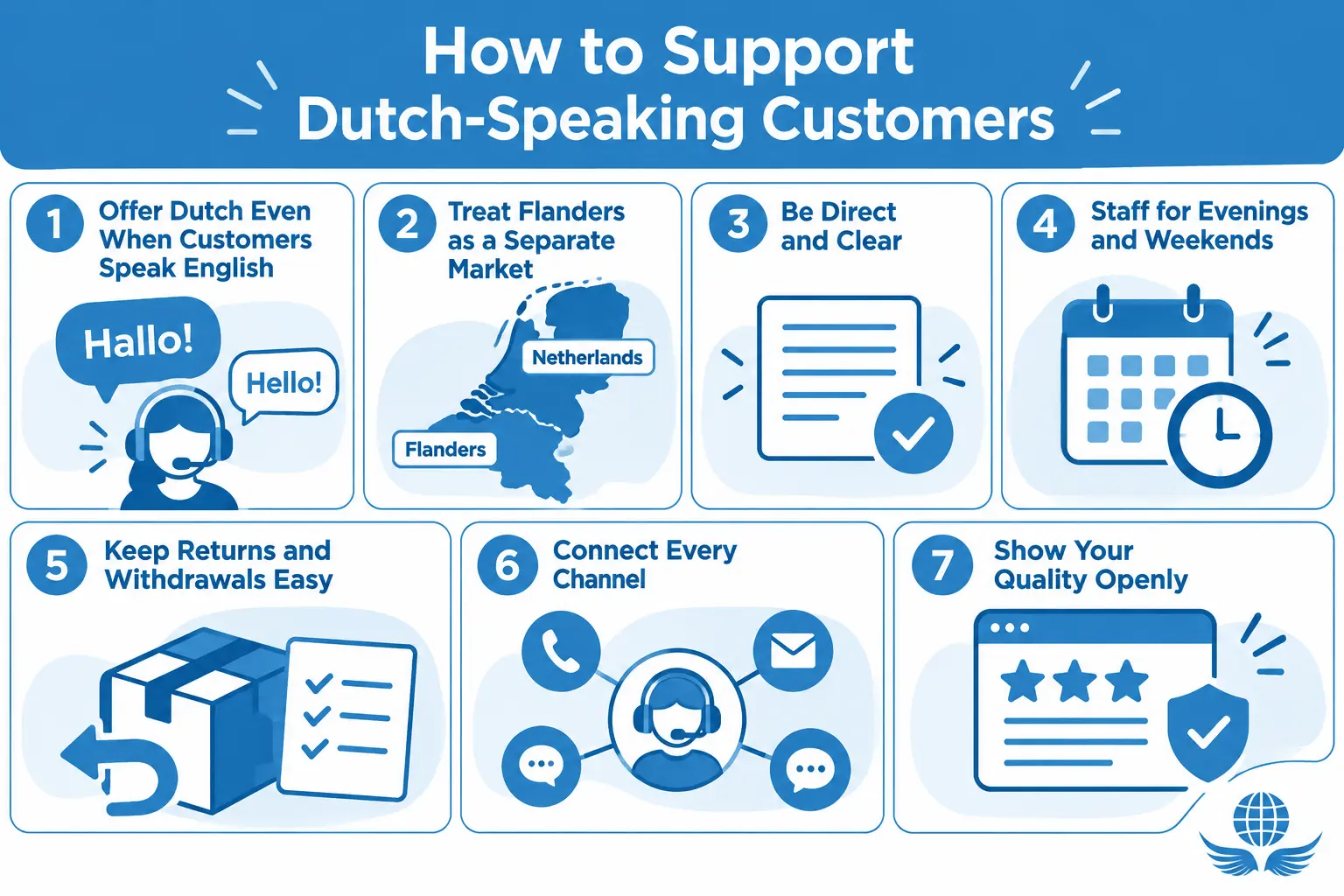
Offer Dutch Even When Customers Speak English
In the 2025 English proficiency rankings, the Netherlands came in first out of 123 countries. So why offer Dutch support at all?
Not everyone who speaks English wants to handle a billing issue in English. People can purchase in English without giving a second thought. Many don’t bother to argue in a second language when a return, renewal, or dispute goes wrong; they simply leave. Your data rarely shows why.
Offer customer service in Dutch for these moments:
- Refunds and returns/billing disputes
- Renewal and cancellation of contracts
- Complaints and technical faults
- Money and legal jargon
- If volumes are low, begin with these contact types.
Treat Flanders as a Separate Market
Belgium is not a side region of the Dutch market. It requires its own plan. On 1 January 2026, there were 6,898,350 inhabitants, which is more than 50% of Belgium’s population.
Flanders callers know when an agent has a Dutch accent. Vocabulary, pronunciation, and politeness differ.
| Factor | Netherlands | Flanders |
|---|---|---|
| Form of address | Brands often use the informal you | Customers often expect the formal you |
| Tone | Very direct | Direct but more reserved |
| Vocabulary | Netherlands Dutch | Belgian Dutch with local terms |
| Other languages | English widely used | French also common across Belgium |
Our French call centre services can cover Brussels and Wallonia under the same contract.
Be Direct and Clear
Dutch customers value honesty over everything. A long, scripted apology can make it seem like the agent is avoiding the question.
Train agents to answer in three steps:
- Explain what you can do.
- Explain what you can’t do and why.
- Confirm the next step and when it will happen.
For instance, rather than a lengthy apology, the agent acknowledges the refund, explains when it will be received, and provides written confirmation.
Hire Native Agents for Each Market
Native Dutch speakers catch the local tone and phrasing that learners miss. They also know when simple language works better than extra politeness. Their written Dutch is neat as well, and minor mistakes reflect on a brand’s lack of care.

Good Dutch-speaking customer service is crucial. An Antwerp caller should reach an agent who sounds local to Flanders. Our Dutch call centre staffs the Netherlands and Flanders separately for this reason.
Staff for Evenings and Weekends
In the Netherlands, many consumer questions come in during evenings and on weekends. A team that only works during office hours misses out on the busiest times.
Plan around your actual contact data, not a typical nine-to-five day. European evenings fall in Toronto’s early afternoon and Vancouver’s morning. Build in extra space before sales activities and vacation periods.
Keep Returns and Withdrawals Easy
Under EU regulations, cancelling a purchase is now a simple online process. Online traders must provide an easy-to-find withdrawal function for consumers since 19th June 2026.
Your support team should match that standard:
- Write confirmations for withdrawals and returns.
- Make cancellation as easy as purchasing.
- Clearly explain refund timing in Dutch.
- Educate agents to work with the request, not against it.
Connect Every Channel
Support Dutch customers via phone, e-mail, chat, and social media. Place them all in a single queue with a single history. This is truly omnichannel support.
If a customer starts a conversation in chat and it’s transferred to phone, the customer should not repeat the order number. Set up response goals for every channel and monitor them weekly.
Show Your Quality Openly
Dutch buyers/procurement want proof, not promises. Provide readable quality scores, sampled call recordings, and agent names on your account. Be prepared to share GDPR documents with procurement teams.
Measure and monitor customer satisfaction and repurchase rates for the Netherlands and Flanders. One market may be strong while the other is weak, and this may not be reflected in the total score. Repeat purchases are a true sign of customer loyalty.
How Can a Canadian Business Staff Dutch Support?
Central Europe is 6 hours ahead of Toronto and 9 hours ahead of Vancouver. If you have a team in Canada, they would need to work at night when it’s a business day in the Netherlands.
| Staffing Model | Best For | Main Drawback |
|---|---|---|
| In-house team in Canada | Very low Dutch volume | Cannot cover European hours well |
| Direct hires in the Netherlands | Large, long-term programs | Tight labour market and rising wages |
| Outsourced dedicated Dutch team | Growing programs in both markets | Needs a clear handover of product knowledge |
| Shared English answering service | Simple English calls only | No Dutch coverage |
For most brands, the best way to provide Dutch-speaking customer support is to hire an external customer support team. Our bilingual customer service teams also use a single queue for Dutch- and English-speaking callers.
About one million people of Dutch origin live in Canada. We also have agreements with Aruba, Curacao, and Suriname, where Dutch is widely spoken.
How Is Dutch Customer Care Priced?
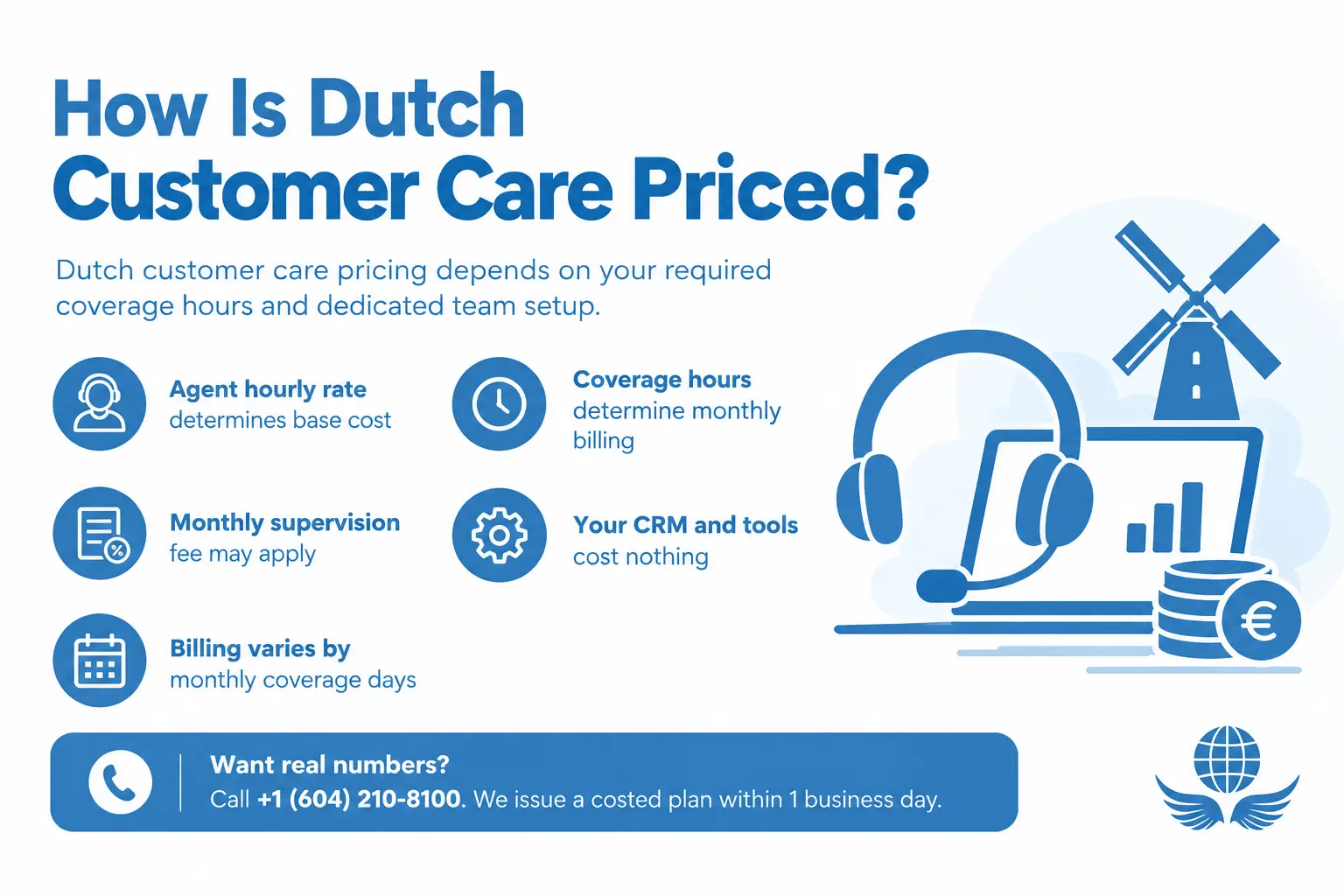
Dutch customer care is priced by the hours you need covered, because it runs on a dedicated team.
Our shared 24/7 answering service uses minute-based plans and covers English calls only.
The dedicated Dutch teams follow a very simple formula:
- The agent hourly rate
- Multiplied by the coverage hours you agree on
- Plus monthly supervision fee
There’s no additional cost for using your own CRM and tools. Billing is based on the hours covered, so February costs are slightly lower because it is not a 31-day month.
Want real numbers? Call +1 (604) 210-8100. We issue a costed plan within 1 business day.
How is Agents Republic Providing Dutch Support Services?
Agents Republic is a Canadian firm, headquartered in Vancouver, with an office in Budapest, offering call centre services to clients in Canada, Western Europe, and the USA.
Our Dutch support services are staffed by Dutch-speaking agents recruited for each market. We are PCI DSS certified and GDPR compliant, with a BBB A+ rating. Multilingual customer service for European markets remains in the same contract as you expand.
Final Thoughts
Strong Dutch customer service is native, direct, and local. It is a standalone market for the Netherlands and Flanders,s and it makes clear statements where money is concerned.
If you nail these few things, then the Dutch customer experience will keep customers from leaving.
Are you prepared to help customers in the Netherlands & Flanders? Call +1 (604) 210-8100 to plan your Dutch team today.
Frequently Asked Questions (FAQs)
Do Dutch customers really need support in Dutch?
In many basic sales scenarios, no. Yes, for returns, disputes, renewals, and complaints. These are the times when customers need their own language. Many will leave quietly rather than arguing in English. Providing Dutch support for these conversations helps safeguard income that is usually lost when these conversations are handled in English only.
Can one team support the Netherlands and Flanders?
It can, for simple, low-volume work. Callers in Flanders speak differently, with different tones and forms of address, and they quickly notice when an agent sounds Dutch. As volume grows, it is better to have dedicated agents for different markets. If a brand sells throughout Belgium, French may be required too, for Brussels and Wallonia.
How direct should agents be with Dutch customers?
Quite direct. In the Netherlands, customers prefer honest, clear answers over lengthy, scripted apologies. Agents should indicate what they can do, what they can’t do, and what will happen next. This style is courteous in Dutch culture. Flemish customers also appreciate clarity, but they may prefer a more reserved, formal tone in all responses.
Which hours should the Dutch support cover?
Cover at least Central European business hours. Many consumer questions also come in during the evening and on weekends, so longer hours help. In Canada, those hours fall at night and early in the morning. A dedicated partner provides a local agent working European hours, so your Canadian staff doesn’t have to work after hours.
How does Dutch customer support fit with other languages?
Often, the Dutch support expands to a larger Benelux program. Belgium adds French, and many brands require German or English. A single partner can route all callers by language and market in a single queue. That helps avoid transfers, keep reporting in one place, and make expansion easier as new markets open.

