
Customer service representatives held about 2.7 million US jobs in 2025, and that number is projected to fall 5% by 2035 as self-service, apps, and social channels take over simple tasks. Support isn’t diminishing. It’s spreading to more channels.
That shift sits at the heart of the call center vs contact center question. Voice and phone calls are processed by a call center. A contact center manages phone, email, chat, SMS, and social media.
This guide will answer the question of what a contact center or call center is, analyze both models, and explain how to choose one of them.
Already know your channels? Request a quote, and we will match a model to your needs
Key Takeaways
- The core call center vs contact center split is channels: phone only, or phone plus digital channels.
- Every contact center includes call center work, but not every call center supports other channels.
- Contact centers rely more on shared customer data, CRM connections, and channel routing.
- If your customers primarily call you, a call center may be the better option.
- Both models can be outsourced to a partner with the people, tools and reporting.
What Is a Call Center?
A call center is a group of people that answer customer calls. Agents answer incoming or outgoing calls, or both. The goal is to resolve problems, take orders, or communicate with consumers by voice only.
How a Call Center Works
Each call goes through a phone system that directs it to the appropriate agent. The agent accesses the customer record, processes the request, and records the result. Supervisors monitor call volume, wait times, and quality.
Types of Call Centers: Inbound and Outbound
Inbound teams take incoming calls from customers, whether that be inquiries or grievances. Outbound teams make the first call, such as a welcome call, a reminder, or a sales call. Inbound vs. outbound call center service is explained in detail here.
Common Call Center Services and Use Cases
- Order lines: Orders are processed and paid for over the phone.
- Bookings: Agents use bookings and reservations to book and alter visits.
- Help lines: Tier 1 agents resolve common issues using technical support.
- After-Hours Answering: A 24/7 answering service is available after hours, nights, weekends, and holidays.
What Is a Contact Center?
A contact center is a team that manages all customer interactions across multiple channels from a single platform. Phone is still part of it. The difference is that all channels share the same customer history and routing rules.
How a Contact Center Works
All messages, calls and chats go into a single queue. It’s routed to an agent who has the appropriate skill. The agent can view past contacts across all channels, so the customer doesn’t have to repeat their story.
Communication Channels Supported by Contact Centers
- Voice calls and voicemail
- Email and web forms
- Live chat and messaging apps
- SMS text messages
- Social media messages
What Is Omnichannel Customer Service?
It connects each channel into a single thread. A customer can start a conversation via chat and then call, and the agent will pick up where the customer left off.
Call Center vs Contact Center: Key Differences
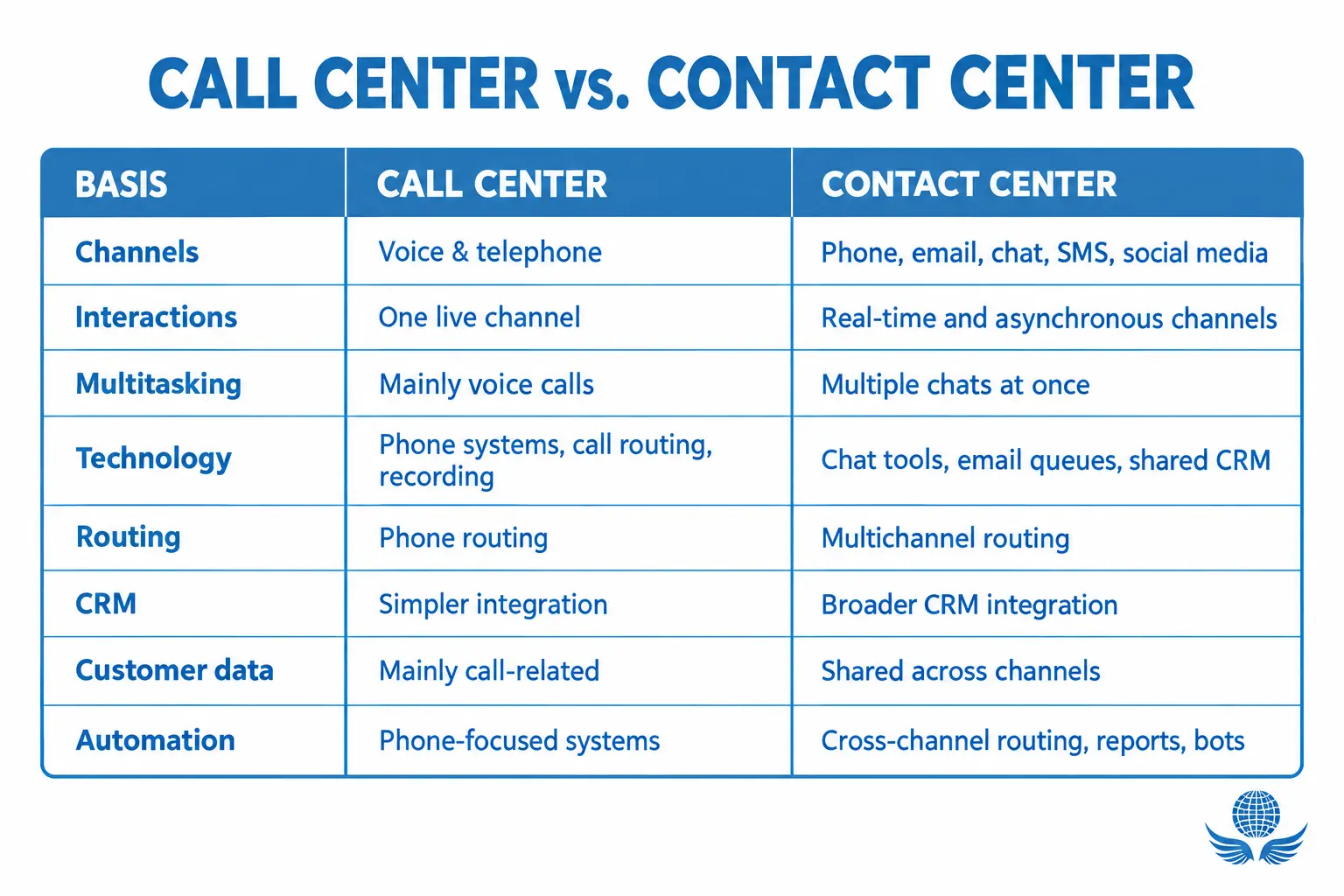
Thinking about the difference between call center and contact center? Call center and contact center models differ in the number of channels.
- A call center uses only voice and telephone for communication.
- A contact center handles phone plus digital channels, such as email, chat, SMS and social media, in one connected system.
That one gap alters everything else. Contact centers require multi-channel routing, expanded CRM integration and more agents with writing skills than talking ones.
Call centers can remain simple, relying on telephone systems, call scripts, and voice skills. Contact center agents have a better view of the past and therefore respond quicker.
When nearly all demand comes in by phone, call centers are typically less expensive to establish and operate. Neither model is better by default. This depends on how your customers prefer to connect with you, the volume of contacts you receive, and the complexity of your support.
Communication Channels and Customer Interactions
Call Centers operate in a single live channel. CA contact center combines real-time channels (voice and chat) and slower channels (email). Written channels let agents handle several chats at once.
Technology, Automation, and Customer Data
Phone routing and call recording are essential parts of call centers. Contact centres introduce chat facilities, email queues and a single CRM. All routing, reports and bots in all channels run on that shared information.
Agent Skills and Customer Service Responsibilities
Call center workers should have strong communication skills, patience, and a sharp mind. These skills, along with strong writing, are essential for contact center agents. They must also maintain a consistent tone across channels.
Customer Experience and First Contact Resolution (FCR)
First Contact Resolution (FCR) indicates whether agents resolve the issue during the initial contact. FCR can improve because agents have access to the full history. When problems are straightforward, call centres can handle them easily.
Operational Costs, Scalability, and Performance Metrics
Call centers are less expensive when traffic is predominantly voice. Contact centres require higher investment and are multi-channel. Call centers track answer speed and handle time. Contact centers combine response times across channels.
Call Center vs Contact Center Comparison Table
Use this call center vs contact center table as a quick reference.
| Factor | Call Center | Contact Center |
|---|---|---|
| Channels | Phone only | Phone, email, chat, SMS, social |
| Routing | Call queues | Shared queue across channels |
| Customer data | Call notes | Full history from every channel |
| Agent skills | Voice skills | Voice and writing skills |
| Setup cost | Lower | Higher |
| Best for | Phone-heavy support | Customers who switch channels |
Call Center Agent vs Customer Service Representative
The call center agent vs customer service representative question is one of scope. A call center agent works primarily by phone. The other can work across channels.
Roles, Responsibilities, and Required Skills
Both positions respond to queries, solve problems and record all contact entries. A Customer Service Representative can also respond to messages in email, chat, or social media. That takes writing ability and channel switching.
When These Roles Overlap
In most contact centers, these roles overlap. One agent may take calls in the morning and handle chat in the afternoon. Whether you have the title or not, it’s all about the training.
Essential Technologies Behind Call Centers and Contact Centers
Tools determine how quickly customers can reach the right person.
Automatic Call Distributor (ACD) and Intelligent Routing
A Call Queuing system is called an Automatic Call Distributor (ACD) because it sends each call to the best available agent. Smart routing includes rules based on skill, language,e or urgency. For instance, a French caller in Quebec is routed to a French-speaking agent first.
Interactive Voice Response (IVR) and Self-Service
Interactive Voice Response (IVR) lets callers use their voice or keypad to select options. It can answer simple questions, e.g., store hours. It also routes complex calls to the appropriate team.
Cloud Contact Center Solutions and CRM Integration
A cloud contact center operates online, rather than on office hardware. Agents can access it from anywhere, with security in place. Each agent sees the customer’s full history through a CRM link.
AI, Analytics, and Quality Assurance
AI tools now cap calls and flag quality issues. Among the 10 business functions surveyed, service leaders dedicate a median of 12% of their 2025 budget to AI, the largest share. People still need to check the work, as quality depends on judgment.
Benefits of Choosing a Call Center
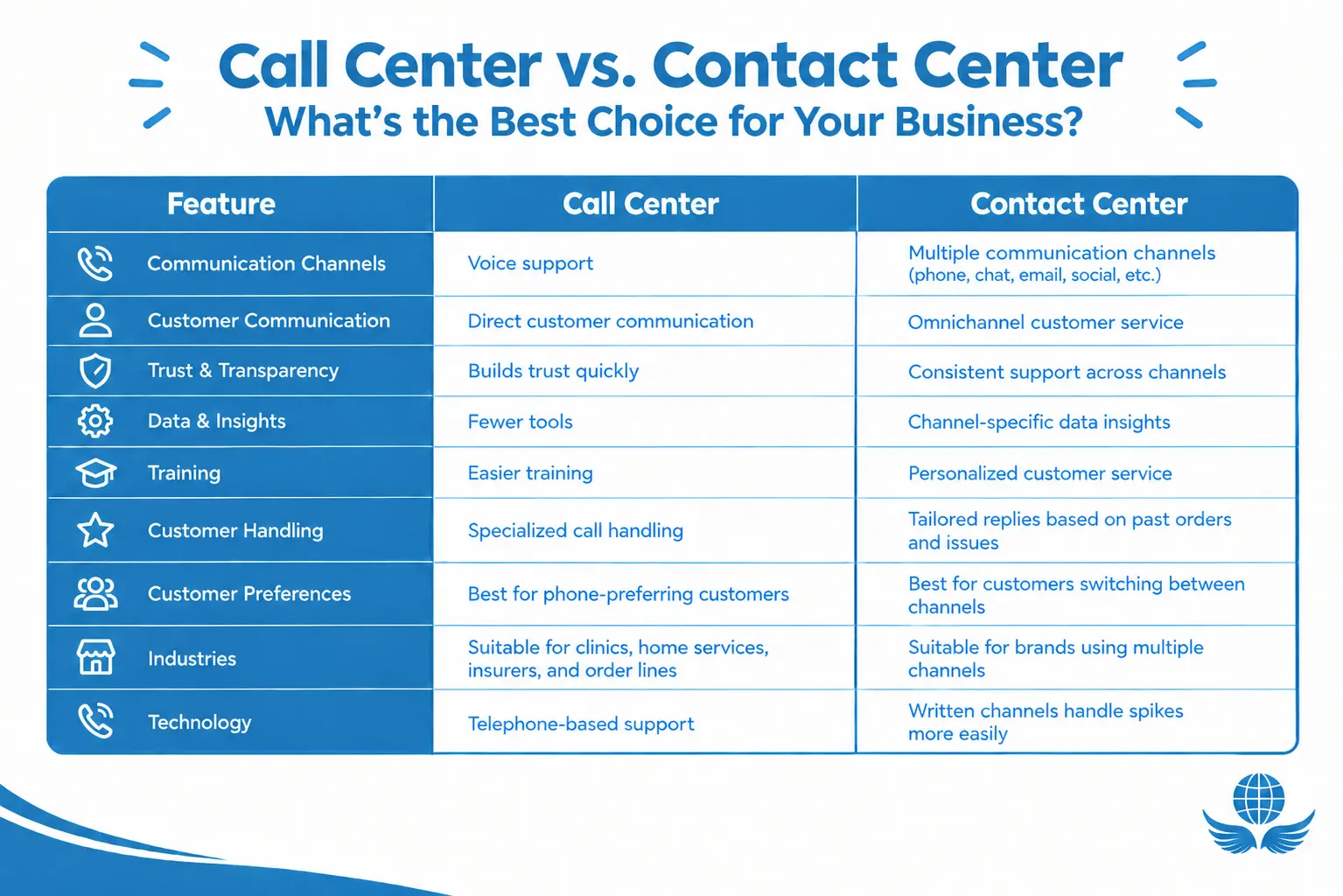
In the call center vs contact center debate, a call center wins when your customers prefer to phone. A contact center fits brands whose customers move between channels.
Focused Voice Support and Direct Customer Communication
TVoicesupport fbuildstrust rquickly Customers hear a human voice, and tone carries meaning that text cannot convey.
Cost Efficiency and Specialized Call Handling
One channel means fewer tools and easier training. Agents learn to become adept at call processing.
Best-Fit Business Scenarios
Call centers can fit clinics, home services, insurers and order lines. An answering service for small business is a great way to get started.
Benefits of Choosing a Contact Center
Omnichannel Customer Service and Consistent Support
Customers receive the same answer across all channels. Customers don’t have to tell their story over and over again.
Improved Customer Insights and Service Personalization
Each channel’s data provides insight into why customers are contacting us. Agents can tailor each reply to past orders and issues.
Scalability, Automation, and Better Customer Experience
Written channels absorb spikes more easily than telephone lines. Bots handle simple requests, while agents focus on complex ones. Get inbound contact center solutions that help in real time.
Weighing both models? Call +1 (604) 210-8100, and we will review your channel mix with you.
Should You Outsource a Call Center, or Contact Center?
Whether you choose a call center or contact center, outsourcing is usually faster than building a team. For Canadian and American companies, the partner provides agents, tools, and team leads.
What Is an Outsourced Contact Center?
An outsourced contact center is a partner with whom you share customer contacts across different channels. Call center services include phone, email, chat, and social media. Dedicated teams work in over 100 languages, including French call center services, Spanish call center services, Japanese call center services and Korean call center services.
In-House vs Outsourced Call and Contact Center Services
An in-house team pgivesyou wirect control, but you must hire, provide tools, and supervise. Call center representatives in Canada typically make between $16.00 and $33.14 per hour, before additional costs. An outsourced partner packages these services into a single rate.
The Merits of Business Process Outsourcing (BPO)
Business Process Outsourcing (BPO) provides trained agents, long hours, and room to grow. It also helps you save money on hiring and staff turnover. Our guide to outsourcing call centers explains the full process.
When to Consider Contact Center Outsourcing Consulting
Contact center outsourcing consulting helps when you don’t know which channels, hours, or languages you need. A good partner reviews your contact data before quoting.
How to Choose the Right Solution for Your Business
Don’t base your decision on trends; use data when choosing between a call center and a contact center.
Evaluate Your Customers’ Preferred Communication Channels
Check where contacts arrive today. If more than most come by phone, begin with a call center. If customers use several channels, choose a contact center.
Evaluate Budget, Call Volume, and Business Growth
Estimate monthly volume and peak hours. Our Erlang Staffing Calculator indicates how many agents you need.
Compare Service Levels, Security, and Reporting
Request PCI DSS and GDPR credentials, sample reports, and the agent-to-team-lead ratio. We have 12% agent turnover, and our average is 17 agents per supervisor.
Questions to Ask Before Selecting a Service Provider
- Which channels and languages can you staff today?
- How do you train agents on our products?
- Which reports will we get and how often?
- How is pricing calculated, and what is extra?
- Can we begin with a pilot?
Our RFI questions for call center outsourcing add more.
Final Verdict: Which One Do You Need?
It ultimately depends on the customer when you’re deciding between a call center vs contact center.
Choose a call center if most contacts arrive by phone and your support is simple. Choose a contact center when customers move between channels or need more in-depth support.
Agents Republic is a call center outsourcing Canada provider with offices in Toronto and Budapest. We are BBB A+ rated and PCI DSS and GDPR compliant.
Call +1 (604) 210-8100 or contact our team to choose the right model today.
Frequently Asked Questions
What Is the Difference Between Call Center and Contact Center?
Anyone asking what the difference between a call center and a contact center is needs one answer: channels. A call center only receives phone calls. A contact center can manage phone, email, chat, SMS, and social media in a single system and share customer history.
What Is a Contact Center or Call Center?
Both are teams responsible for handling business interactions. A call center operates over the telephone line, via inbound or outbound calls. A contact center includes phone and digital channels. Each channel can be in-house or outsourced.
Is a Contact Center Better Than a Call Center?
Not always. A contact center can be better than a call center for customers who use multiple channels. The more telephone contacts, the more money a call center makes, since it’s cheaper. Mirror the model with your customers’ approach.
Can a Call Center Provide Omnichannel Customer Service?
By adding channels and shared systems. When a call center connects phone, email, and chat to a single customer record, it becomes a contact center. Many teams make this change gradually, starting with email or chat alongside phone support.
What Is the Difference Between a Call Center Agent and a Customer Service Representative?
A call center agent’s primary task is to handle incoming calls. Customer service representatives can work by phone, email, chat, or social media. The skills are similar, but contact center representatives write more and switch mediums more often. more often
How Much Does It Cost to Outsource a Contact Center?
It depends on channels, hours, languages, and skills. Simple English Plans based on usage time are included. Dedicated teams are charged based on the agent’s hourly rate and the number of hours used for coverage, plus a fixed monthly supervision fee. Request a full quote from each provider.

