
Automation can answer simple questions, but it can’t replace talking to someone who understands. Your customers know the difference. A Harvard Business Review study of nearly 12,000 consumers in 11 countries found that empathy matters more to buying decisions than reviews or recommendations, yet 78% of respondents said businesses do not genuinely care about them.
Most support teams have this gap. The right words, said at the right moment, show customers that someone is listening and ready to help. This guide gives you 60 empathy statements for customer service that you can use today, plus real conversation samples, phrases to avoid, and practical tips for training your team.
Whether you lead a contact center or answer calls yourself, these empathy statements for customer service will help every customer feel heard.
What is an empathy statement in customer service?
An empathy statement is a short line that names the customer’s feeling or situation and then moves toward a solution. Example: “I can see you were counting on this order, and I’m sorry it’s late. I’ll send you the tracking link right now.”
Key Takeaways
- Customer empathy is knowing how your customer feels and responding in a way that helps them reach a solution.
- An empathy statement works best when the agent follows it with an action or next step right away.
- Sympathy is feeling sorry for the customer; empathy is understanding their situation and acting on it.
- The 60 empathy statements below cover feelings, apologies, listening, thanks, solutions, saying no, phone calls, follow-up, and multilingual customers.
- Empathy statements for saying no, and for multilingual customers, are included, so agents always have an alternative to offer.
- CSAT, effort scores, sentiment analysis, and QA scorecards based on call recordings are all ways to measure empathy.
What Is Customer Empathy?
At its core, customer empathy is the ability of a brand (especially its front-line agents) to deeply understand a customer’s feelings, motivations, frustrations, and context, and to respond in a way that reflects that understanding.
Empathy goes beyond politeness or good manners. It means stepping into the customer’s shoes, seeing the situation from their point of view, and responding in an emotionally intelligent way.
In customer support, this means:
- Listening with intention (and not rushing to solutions)
- Acknowledging the customer’s feelings by expressing understanding, for example, saying, “I can see how that situation could be frustrating.”
- Adjusting tone, language, and pace based on how the customer is feeling
- Taking thoughtful action to resolve, reduce, or reassure
Because of this depth, empathy becomes measurable and trainable over time, especially when combined with emotional intelligence in customer support, sentiment analytics, and structured coaching.
Empathy Statement: Before and After
The difference shows up in practice. Here is the same message with and without empathy:
The difference in practice is as follows:
- Without empathy: “Your order is delayed. It will arrive Friday.”
- With empathy: “I can see you were counting on this order, and I’m sorry it’s late. It’s now set to arrive Friday, and I’ll send you the tracking link right now.”
Both responses contain the same facts. Only the second one makes the customer feel understood. An empathy statement works only when action follows it. Kind words without action sound artificial.
Empathy vs. Sympathy in Customer Service | With Examples
To help demonstrate this, here are some sympathy and empathy in customer service examples.
- Sympathy: feeling sorry for the customer’s problem from the outside.
- Empathy: understanding the problem from the customer’s side and responding to what they need.
| Factor | Sympathy | Empathy |
|---|---|---|
| Focus | The agent’s feelings (“I feel bad”) | The customer’s experience (“You were counting on this”) |
| Result | Comfort, but no movement | Understanding, then a next step |
| Customer hears | “They feel sorry for me” | “They get it, and they’re going to help” |
Example 1: Late Delivery
- Sympathy: “Oh no, I’m so sorry to hear that.”
- Empathy: “You planned around this delivery, so a delay is a real problem. Let me find out exactly where it is.”
Example 2: Billing Error
- Sympathy: “That’s unfortunate.”
- Empathy: “Being charged twice is stressful, especially when you didn’t expect it. I’m refunding the duplicate charge now.”
Example 3: Service Outage
- Sympathy: “Sorry you’re having trouble.”
- Empathy: “Losing service during your workday is disruptive. Here’s what’s happening and when we expect it to be fixed.”
Sympathy is not wrong, but on its own it leaves the customer where they started. They are propelled by empathy.
Why Empathy in Customer Service Matters
Empathy in customer service isn’t an optional add-on. It affects satisfaction, loyalty, referrals, and defusing aggravated calls. The effect is compounded by proactive customer service, e.g., before they are affected by the delay, of course.
Improved Customer Satisfaction and Retention
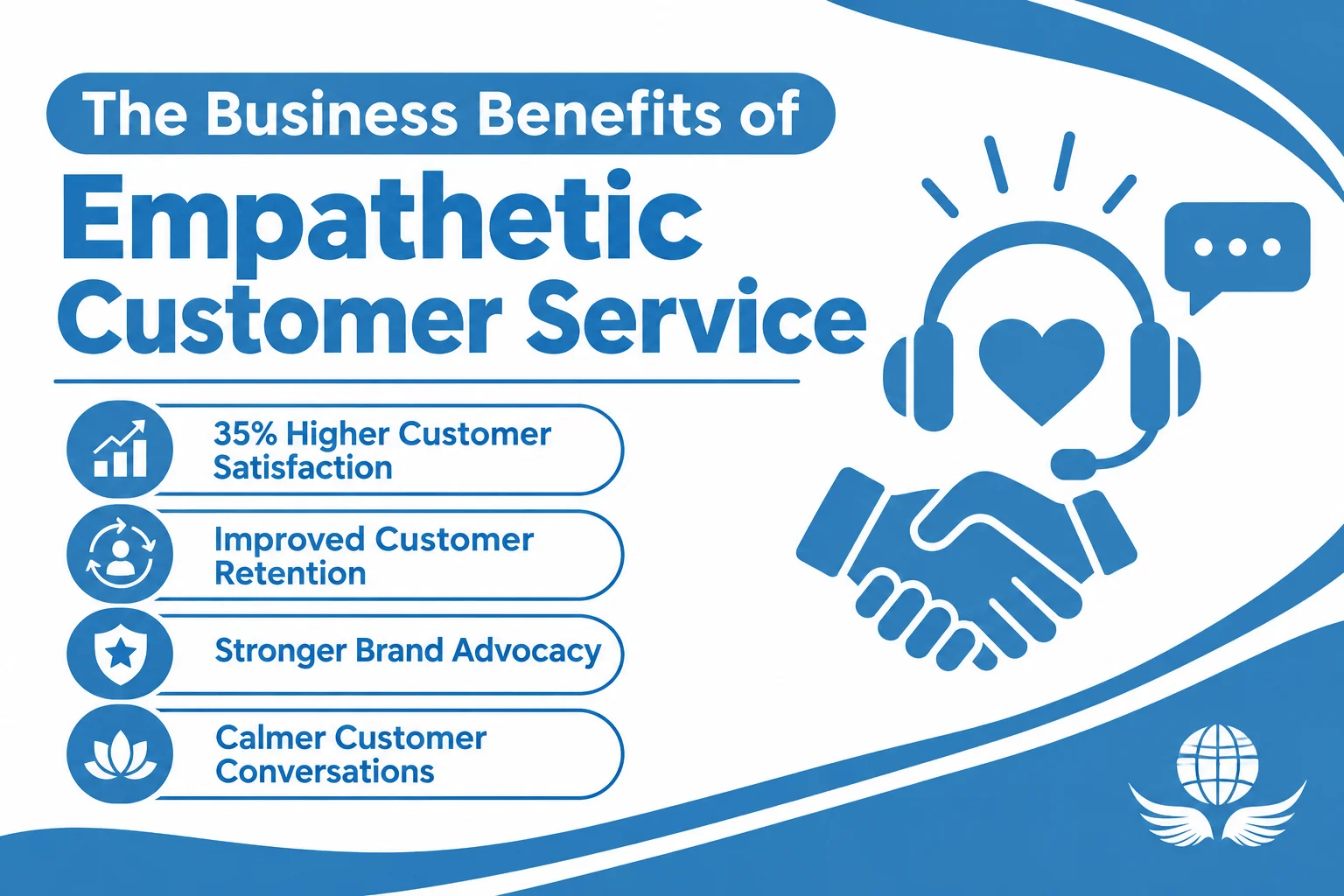
SQM Group studies revealed that customer satisfaction is 35% higher when customers believe the agent demonstrated empathy to them. According to the 2026 report by CX Dive, an analysis of 35.1 million support conversations revealed that conversations with explicit emotional validation received a higher satisfaction rating, but were found in only approximately 18% of conversations.
Fueling a Customer Centric Approach
Empathy takes the efforts from transactional to relational. A knowledgeable agent who has a grasp of their clientele can be more specific in their responses, rather than copying and pasting a neutral response. This type of personalized communication can cause your clients to feel desired, and it will also help employees to be more acquainted with their customers’ requirements when discussing your products or services.
Stronger Brand Advocacy and Loyalty
Successful clients stay longer and advocate for your brand as well as standing up for it when others are complaining about it. The statement holds true in the opposite direction as well. PwC study revealed that one-third of all customers would leave a brand they cherish after experiencing at least one negative experience.
Better Conflict Resolution and Calmer Conversations
After expressing understanding, as well as trying to calm down and acknowledging feelings, that stressful phone call can turn around in seconds. A Peer reviewed study revealed that empathy helps consumers to forgive a service failure from the business, thereby making them more likely to keep purchasing the product.
How to Use Empathy Statements: The 4 A’s
The 4 A’s provide agents with a straightforward framework for all challenging conversations. Each step relates to one job, and each job will have an empathy statement.
Awareness
Pay attention to tone, words, speed, feelings, and background. Be mindful of the client’s situation.
- Sample Statement: “It sounds like this has happened more than once. Is that right?”
Acknowledgment
Say out loud what you notice. (“I can see how that would be frustrating,” “That sounds really stressful.”)
- Sample Statement: “I can see why that would be frustrating.”
Adjustment
Be mindful about the way you communicate, the speed at which you go, how much detail you share, and how you approach solving a problem with them, considering their emotional state.
- Sample Statement: “Let’s take this one step at a time.”
Action
Follow through with a helpful resolution, or a plan designed with some empathy. (Even if partial).
- Sample Statement: “Here’s what I’m doing right now to fix it.”
In some frameworks, the fourth A is Advocacy (going beyond the fix), and the customer is left feeling “helped”, not just listened to.
60 Empathy Statements for Customer Service
Listed below are 60 empathy statements, broken down by situation for empathizing with feelings. Use them as a guideline and adapt them to fit your own style.
1. Empathy Statements to Acknowledge Feelings
These will be used at the start of a conversation, at the initial stage of the customer’s complaint.
- “I can hear how frustrating this has been for you.”
- “That sounds really stressful, and I want to help sort it out.”
- “I’d feel the same way if this happened to me.”
- “It makes sense that you’re upset about this.”
- “I understand why this matters so much to you.”
- “That’s not the experience we want you to have.”
- “I can see this has taken up a lot of your time.”
- “You have every right to be disappointed.”
2. Empathy Statements for Apologizing
Use these when the company has erred. Indicate what was wrong.
- “I’m sorry we got this wrong. Let me make it right.”
- “I apologize for the mix-up. That shouldn’t have happened.”
- “I’m sorry you had to contact us more than once about this.”
- “You’re right, and I apologize. This was our mistake.”
- “I’m sorry for the wait today, and thank you for staying on the line.”
- “I apologize that nobody explained this to you sooner.”
3. Empathy Statements for Active Listening
Use these to check what was said and let them know you are listening.
- “Just so I’m sure I’ve got it right, you’re saying…”
- “Can you walk me through what happened, step by step?”
- “Let me repeat that back to make sure I didn’t miss anything.”
- “What would a good outcome look like for you today?”
- “I’m writing this down so you won’t have to explain it again.”
- “Is there anything else about this that’s worrying you?”
- “So the main problem is [issue], and it started on [date]. Is that right?”
4. Empathy Statements to Thank the Customer
These can be implemented to thank the customer for their time, patience, and feedback.
- “Thank you for being so patient while I looked into this.”
- “Thanks for letting us know. This helps us fix it for other customers too.”
- “I really appreciate you explaining it in so much detail.”
- “Thank you for giving us the chance to fix this.”
- “Thanks for sticking with us. I know this hasn’t been easy.”
- “I appreciate your honesty. That feedback helps.”
5. Empathy Statements for Offering Solutions
When a problem has already been understood, use these when it is time to start working towards a solution.
- “Here’s what I can do for you right now.”
- “Let’s work on this together until it’s fixed.”
- “I’ve found two options. Let me explain both so you can choose.”
- “I’m going to take care of this personally.”
- “The fastest way to fix this is [solution]. Would that work for you?”
- “I’ve already started the refund, and you’ll see it in [timeframe].”
- “I won’t end this call until we have a plan you’re happy with.”
6. Empathy Statements When You Can’t Give the Customer What They Want
When you need to say “no” due to policy, timing, or cost, use these. Always provide an alternative!
- “I wish I could do that for you, and I understand why you’re asking.”
- “I can’t change that, but here’s what I can do.”
- “I know that’s not the answer you were hoping for.”
- “That option isn’t available, but let me find the closest thing to it.”
- “I hear you. Let me check with my supervisor to see if there’s anything else we can offer.”
- “Even though I can’t approve that, I don’t want you to leave without a solution.”
- “I understand this is disappointing. Here’s what you can expect next.”
7. Empathy Statements on the Phone: Holds, Transfers, and Callbacks
However, when you are talking to the individual via the phone, they are unable to see you; hence, your words and tone convey all the empathy.
- “Would it be OK if I put you on a brief hold? It should take about two minutes.”
- “Thank you for holding. I know waiting isn’t fun.”
- “I’m going to connect you with our billing specialist. I’ll stay on the line to explain your situation, so you won’t have to repeat it.”
- “If we get disconnected, I’ll call you right back on this number.”
- “I’d rather not keep you waiting. Can I call you back by 3 p.m. with the answer?”
- “I can hear there’s a lot going on around you. Take your time.”
- “I’m sorry you had to wait so long to reach us today.”
- “I’m still here; I’m just pulling up your account.”
Want agents trained to sound like this on every call? Talk to Agents Republic.
8. Empathy Statements for Following Up and Closing
Use them to end the discussion and make sure that the issue is not forgotten.
- “I’m calling to check that the fix is still working for you.”
- Is there anything else I can help you with today?”
- I’ve added a note to your account, so anyone you talk to will know the full story.”
- Your feedback has gone to our team so this doesn’t happen again.”
- Thank you for your patience today. I’m glad we got this sorted out.”
9. Empathy Statements for Multilingual and Bilingual Customers
Customers can explain a problem in their native language, avoiding tone clashes due to cultural context. Many customers in Canada have a preference for English or French, and throughout North America many prefer Spanish. Our guides to multilingual customer support and support in a customer’s native language explain why this matters.
- “Would you prefer to continue this conversation in French or Spanish?”
- “I’ll put you in touch with a colleague who speaks your language, and I will provide your details, so you don’t have to repeat it.”
- “Please take your time; there’s no hurry, and I’m happy to slow down.”
- “If any part of my explanation isn’t clear, let me know, and I’ll say it another way.”
- “I will send you a written summary of all the things we agreed on so that you can read through it at your own pace.”
- “Thank you for your patience while we find the right person to help you in your preferred language.”
For companies requiring native speakers, extended multilingual capability can be achieved with dedicated teams, such as Spanish call center services or French call center services.
Empathy Statement Examples in Real Conversations
Examples of empathy statements that include the 4 A’s in real-life support conversations:
An Angry Caller Whose Order Is Late
Customer: “This is the third time I’ve called. Where is my order?”
Agent: “I’m sorry you’ve had to contact us three times about the same issue. That shouldn’t happen [Acknowledgment]. I understand how frustrating it is to wait without knowing when your order will arrive [Awareness]. I’ll take ownership of this rather than asking you to contact the carrier yourself [Adjustment]. I can see your order left our warehouse on Monday but stalled with the carrier. I’ve opened a delivery trace and will call you by 2 p.m. today with an update [Action].”
A Double Charge on a Bill
Customer: “I’ve been charged twice this month, and now my account is overdrawn.”
Agent: “I’m sorry this happened. I understand that an unexpected duplicate charge can create serious financial stress [Acknowledgment]. I can see why resolving this quickly matters, especially when your bank balance is affected [Awareness]. I’ll prioritize checking both transactions and make sure you don’t have to repeat the details to another agent [Adjustment]. I’ve confirmed the duplicate payment and processed a refund. It should appear in your account within three to five business days [Action].”
A Technical Issue Blocking Someone’s Work
Customer: “I can’t log in, and I have a client presentation in an hour.”
Agent: “I understand how stressful this must be with an important presentation coming up so soon [Acknowledgment]. We need to get you access without wasting valuable time [Awareness]. Instead of making you wait for a full technical fix, I’ll first provide a temporary access link so you can retrieve your files. Can you also tell me what error message appears when you try to log in [Adjustment]? I’ll escalate the login issue and email you once the permanent fix is in place [Action].”
A Refund Request Outside the Policy
Customer: “I know it’s been 45 days, but I need a refund.”
Agent: “I understand why you’re requesting a refund, and I wish we could make an exception Acknowledgement]. Our standard refund window is 30 days, so your purchase falls outside the eligible period [Awareness]. While I can’t promise a full refund, I can look at alternatives that may help resolve this for you [Adjustment]. We can offer store credit for the full amount, an exchange, or a supervisor review. Which option would work best for you [Action]?”
A Spanish-Speaking Customer With a Delivery Delay
Customer: The customer, speaking Spanish, says they have waited days and tracking has stopped updating.
Agent: Lamento mucho que haya pasado por esta situación; entiendo lo frustrante que es esperar sin información” [Acknowledgement]. The agent recognizes the customer’s frustrated tone, repeated concerns, and urgency [Awareness]. He slows down, simplifies explanations, avoids jargon, and provides step-by-step updates in Spanish [Adjustment]. He prioritizes the delivery, sets up a follow-up notification, offers a discount or compensation where appropriate, and contacts the customer the next day with an update [Action].
Empathy Phrases For Customer Service to Avoid (and What to Say Instead)
Even when well-intentioned, statements made by customer service agents that welcome empathy can sound patronizing or canned. Replace them with these.
| Avoid | Why it backfires | Say instead |
|---|---|---|
| “Calm down.” | It tells the customer their feelings are wrong. | “I can hear this has been really frustrating.” |
| “That’s our policy.” | It sounds like you are hiding behind rules. | “Here’s why that rule exists, and here’s what I can do.” |
| “I know exactly how you feel.” | It can sound fake, unless you really do. | “I can understand why you feel that way.” |
| “Sorry for any inconvenience.” | It sounds scripted and vague. | “I’m sorry your delivery was late.” |
| “There’s nothing I can do.” | It ends the conversation with no hope. | “I can’t change that, but here’s what I can do.” |
| “As I said before…” | It sounds impatient. | “Let me explain that another way.” |
| “You should have…” | It blames the customer. | “Next time, here’s a quicker way to do it.” |
Tips to Make Empathy Statements Sound Genuine
The most effective customer service empathy words are the ones that are spontaneous. All of these tips will ensure that all statements will be natural.
- Individualize: Refer to the client by name and add information provided by the client. Perhaps their order, situation, or deadline, documented in a statement, comes out as much more authentic than a generic statement.
- Match words/expressions on the call with your tone: Body language is as important as words/expressions. If the caller is distressed, don’t rush and remain calm.
- Never read a script: Make sure you know what’s been said in your script and reword it. Allow agents to be free to deviate from scripts when appropriate.
- Don’t overuse them: There is no need to say them each time. It’s better to say them once or twice, and well. Avoid doing too much, or it will seem like a scripted conversation.
- Take action: Don’t let empathy be inaction. Add what you are doing to help along with the statement.
- Time it appropriately: acknowledge first, describe/defend second, and solve third. The customer will listen if he feels heard. Note the customer’s mood in your CRM, so that the next agent is aware too.
Is Customer Empathy a Skill? And Can It Be Taught?
Empathy: Trait and Skill
It’s something you can learn, and some people may be more naturally empathetic. Every agent can learn to spot and respond to emotion. It is a question of systematic training, consistent reinforcement, and feedback to be more sensitive to emotions and pick them up as soon as possible.
Training Programs/Coaching
The only way to get accustomed to it is to practice as much as possible. Use the 60 customer service empathy statements and the phrases to avoid as an exercise, with one agent as the angry customer and the other as the agent. Add and implement mirroring exercises, call review/screening, and shadowing with high empathy agents.
Where AI Helps And Where It Doesn’t?
AI can recognize the rising frustration level, and real-time sentiment analysis of the transcript can be used to guide the agents to more insightful replies. However, emotional calls need to be addressed.
Gartner survey shows 64% of customers don’t want companies using AI for customer service. Conversely, a bot-to-human handoff that isn’t in sync is tone deaf, and the path to a person should be easy, too, says TechRadar’s CX analysis. Our AI customer support guide covers the rest.
Use an Empathy Map to Understand Your Callers
An empathy map has four quadrants that will help agents to see what it is like for the caller:
- Says: “I’ve called three times.”
- Thinks: “Nobody here listens.
- Does: Asks for a manager.
- Feels: Ignored and angry.
By defining common types of calls in this way, teams can map out which statements should be used for the call that is coming in.
How to Measure Empathy in Customer Support
Key Empathy Metrics and KPIs
Measure CSAT, CES, and sentiment analysis of transcripts. On the call recording, include a line on the QA scorecard for this to indicate that an “empathy statement used” has occurred. There is a guide for improving customer satisfaction, including related steps.
Feedback Loops & Coaching
Score for empathy with a sample of calls/transcripts weekly. Show good empathy during team meetings, provide recognition to agents who perform well on challenging calls, and conduct frequent refreshers on role plays.
Maintaining Empathy at Scale
Empathy is difficult when agents are fatigued. Inspect workloads, shift agents for equal workloads, set up a safe environment for agents to talk about issues, and promote empathy over efficiency.
Outsourcing Customer Service With Empathy in Mind
One of the most important aspects of picking a support partner while outsourcing support is empathy. We’ve put together a comprehensive outsourcing call centers guide. Look for:
- Empathy training and coaching.
- Cultural competency and language skills.
- Contributing to embedding KPI’s that include empathy and emotional measures.
- Representatives who have the authority to resolve issues.
- Easy scaling and defined responsibility.
Agents Republic serves the United States and Canada with bilingual customer service representatives, including native Spanish and French speakers, and trains them in the customer care empathy statements in this guide. Businesses in California can also explore our Los Angeles call center services.
Our English-language answering service is a 24/7 answering service that will best serve the businesses of simple call needs; meanwhile, we also have full multi-language teams to offer more detailed answering service 24 hours a day, providing value to our clients.
Final Thoughts
In support conversations, customers can recall the emotions. Teaching empathy statements for customer service to your agents can help them have the right words, but that isn’t the point of customer empathy; it’s about listening, adapting, and doing what your customers need. Do some practice with your team where they will get a chance to familiarize themselves with these sayings, know how to use them, and stay empathetic throughout each call. Agents Republic is a BPO Vancouver company that can help businesses translate that experience on a grand scale.
Looking for a way to ensure that every caller feels heard? Agents Republic agents know how to provide empathetic support, available in English, Spanish, and French, 24/7. Call +1 (604) 210-8100 to get started.
Frequently Asked Questions (FAQs)
What Is the Meaning of Customer Empathy?
Customer empathy is the ability to understand and share the emotional state of your customers, not just their questions, but their feelings, frustrations, hopes, and context, and respond in ways that reflect that understanding.
What Is an Empathy Statement in Customer Service?
An empathy statement is very brief and will convey to your customer that you recognize what they are feeling and are ready to help. The first sentence of a good empathetic statement is to state what the customer’s problem is, such as a late order, and then move to the solution of the customer’s problem. It’s best paired with action.
What Are Some Examples of Empathy Statements?
Some examples of this are: “I can hear how annoying and frustrating this has been for you” or “I’m sorry that we’ve got this wrong; let me make it right for you” or “Here’s what I can do for you right now. There are 60 statements in a complete list that cover all aspects of a support conversation.
What Is the Difference Between Sympathy and Empathy in Customer Service?
Empathy is being able to understand what the customer is feeling and help; sympathy is feeling sorry for the customer. A sympathetic agent says, ‘That’s unfortunate.’ An empathetic agent says, ‘Being charged twice is stressful. I’m crediting it back to you now.’ Empathy is about the customer and always results in a next step.
What Should You Not Say to an Upset Customer?
Don’t use phrases that blow off emotions or end the conversation. “Calm down”, “That’s our policy”, and “There’s nothing I can do” are among the top three. Acknowledge, rather than deny, the frustration and explain what you can do about it, even if that is a “no”.
How Do You Show Empathy on the Phone?
Demonstrate empathy on the phone through tone/ pacing/ voice. You should keep your voice low, do not raise your voice, do not talk slower to callers who are upset, and you should call them by name. If a hold is required, state what the hold is, and provide a call back interpretation rather than a lengthy hold.
What Are the 4 A’s of Customer Empathy?
The 4 A’s are Awareness, Acknowledgment, Adjustment, and Action. These build a structured, emotionally intelligent response loop in customer interactions.