
Proactive customer service means helping customers before they ask for help, instead of waiting for a complaint. It includes sending a delivery delay alert, payment reminder, or renewal call before a problem happens. This reduces support calls, saves time, and builds trust and long-term loyalty.
Key Takeaways
- Proactive service is simply making contact to help before the client needs to be helped.
- It can help you lower the number of unwanted calls, minimize churn, and build trust in the long term.
- Best programs involve a combination of customers’ data, automation, and trained agents.
- Continue measuring effectiveness by CSAT, NPS, retention, and the number of incoming contacts.
Most businesses feel they are creating an environment for customers’ issues before they appear. Their clientele do not always agree. Salesforce’s State of Service report of 5,550 service professionals finds that 61% claim that their organization is proactive in addressing issues, but only about a third of customers agree.
Proactive Customer Service is about bridging that gap, about knowing what customers need before they are aware of it. Speed matters too. According to HubSpot Research, 90% of customers rate an ‘immediate’ response as important or very important, and 60% define ‘immediate’ as 10 minutes or less.
The best response is the one that comes first, meaning before the customer asks. In this guide, you’ll learn the elements of proactive service, why it is important, nine ways of using it, and how to measure the results.
What is Proactive Customer Service?
It is providing a service in anticipation of a customer’s need or problem, rather than waiting for the customer to reach out to customer service. The service does not get an alert based on your complaint, but also provides a fix along with a valuable suggestion.
Proactive support could be a call, text, e-mail, or an in-app message, which is what the customer prefers. Proactive help is prompted and relevant; it will be experienced as caring. Any message that does not address a need will be experienced as noise.
Everyday examples include:
- Alert before the customer starts to make a tracking attempt with a new shipping estimate.
- Outage notification that outlines the outage problem and the predicted repair time.
- A reminder to pay a few days prior to the expiration of a card or the bill’s due date.
Proactive vs. Reactive Customer Service
Reactive service is waiting for the customer to report the issue. Proactive service is searching for a problem first.
| Factor | Proactive Service | Reactive Service |
|---|---|---|
| Who starts the contact | The business | The customer |
| Timing | Before an issue grows | After an issue appears |
| Approach | Anticipates needs | Responds to complaints |
| Customer perception | “They’re looking out for me” | “I had to chase them” |
| Outcome | Fewer surprises and more trust | Recovery after frustration |
Imagine the service goes down. If a business does send an alert, stating when the fix is expected, then it will be receiving a lot fewer angry calls than a business that waits for customers to figure it out.
When Reactive Support Is Still Needed
Proactive service cuts avoidable contacts, but it can’t prevent every question. Your customers will always have new questions and unexpected situations and requests, which you may not have thought of. That is why companies require both. An effective inbound team provides answers to what you can’t see coming, and an outbound team handles the ones you can predict.
Why Proactive Customer Service Matters Now
The next phase of customer service is predictive. Now machines learn from past data, individual and group behavior, to identify potential issues early in business. According to Wizr AI, predictive analytics can enable businesses to “anticipate customer needs while streamlining operations.” According to Analytics platforms like DOMO, predictive analytics is the practice of using past information and AI tools to make predictions about future actions.
Customers feel like they are looked after when they are warned of an outage, reminded about a renewal, or the error is corrected before they know about it. It is that sense of care that can be the key to making your customer a loyal customer.
Benefits of Proactive Customer Service
Higher Customer Loyalty and Retention
You’ll retain customers if saving time and stress is one of the advantages. The return on fronting the additional costs is massive: Bain & Co’s work with Frederick Reichheld has discovered that raising retention rates by five percent can lead to profits that rise between 25 and 95 percent, according to the Harvard Business Review.
Lower Support Costs
This reflects that each alert, which answers a question prior to contact, averts a call or ticket. Some of the popular examples are: ‘Where is my order?’ ‘Is the service down?’ The fewer avoidable contacts, the lower the cost per customer.
Better Use of Agents’ Time
Proactive systems minimize firefighting. Agents aren’t dealing with repetitive, unimportant issues and have more time for higher-value, complex conversations. The agents are prepared and work more effectively, and there’s less burnout due to less pressure.
Stronger Brand Reputation
Customers talk about companies that warn them first. Time is of the essence, and a quick delay alert or an unprompted credit after an outage breeds goodwill, which means reviews and recommendations.
More Upsell and Renewal Opportunities
Renewals and upgrades are possible with timely check-ins. If a customer hears from you before their contract is up and is able to glean some good information instead of just a pitch to sell, they are more likely to remain a customer and expand with you.
9 Proactive Customer Service Strategies
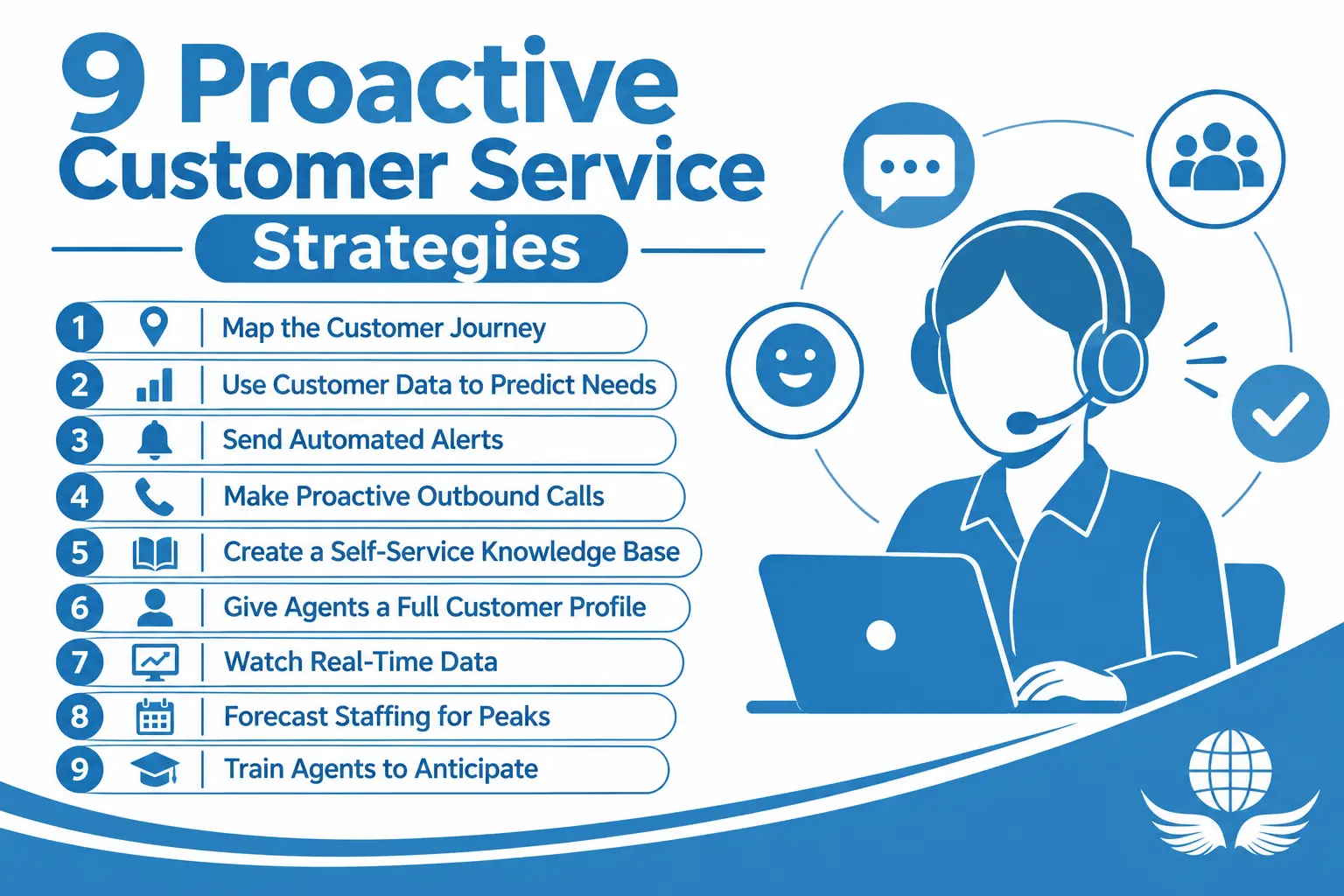
1. Map the Customer Journey and Find the Friction Points
Identify where customers tend to get stuck or reach out, like onboarding, first bill, delivery, and renewal. Analyze your contact reasons to find the question concentration points. For instance, if a number of new clients are contacting you with questions about their first invoice, send them a brief “understanding your first bill” guide prior to the bill.
2. Use Customer Data to Predict Needs and Personalize Outreach
Use past orders, past tickets, and customer use of products to predictively forecast the items for each customer’s next order. Personalization isn’t just about the name: it’s about hitting it right at the right time, the right way, and in the right language. For instance, if a customer has seen a decrease in logins, he/she can be provided a brief tutorial on functions that have not yet been used. Use this data in a responsible way, based on the customer´s expectations.
3. Send Automated Alerts and Reminders
Use notifications for shipment updates, outages, payment reminders, maintenance alerts, and appointment reminders, and activity updates on account statements. Send “how-to” information before the big update, and provide an account credit prior to a known issue before customers gripe. Give your customers a way to prefer to communicate, like SMS, email, or events via your app.
4. Make Proactive Outbound Calls at Key Moments
However, sometimes you need a human voice to be heard. Implement welcome calls, check-in calls prior to renewals, and win-back calls when usage wanes. Outreach should be a regular, not an occasional process with a specially engineered welcome and retention calls program.
5. Create a Self-Service Knowledge Base
FAQs, how-to guides, and troubleshooting articles should be published to help customers easily solve simple problems without the assistance of a support person. Choose the most frequently asked questions by your agents to treat as subjects. Update articles before releases and maintenance when it is scheduled, in case that’s what the customer is looking for.
6. Give Agents a Full Customer Profile
Without knowing all of that, an agent will have to keep guessing what the next question will be. Give them contact details, purchase patterns, history, and preferences all on a single screen. For instance, if an agent can check that the shipment was once attempted without success, the agent can provide them with a solution even before they ask for it.
7. Watch Real-Time Data and QA Trends
Track the changes in contact reasons, customer sentiment touchpoints, and repeat calls over time. When there is a huge increase in calls to some products or error codes, then it is an early warning. Be quick about it with an alert, knowledge base update, or fix so it doesn’t become a serious issue affecting thousands of customers.
8. Forecast Staffing for Peaks
Planning is performed by the staff according to historical data and seasonality conditions to prevent any postponement during peak periods such as the period of product launches, holidays, billing cycles, and others, and save the waiting time of the customers. See the number of agents required for a volume of calls with the free Erlang staffing calculator.
9. Train Agents to Anticipate, Not Just Answer
Practice active listening and customer empathy, or “next issue avoidance”; work out the next question the customer is going to pose. Lastly, conduct regular surveys of your consumers, and tell them what you have done differently because of their input.
Tools and Technology
Typically, proactive programs are built on a CRM, AI agents & chatbots for frequently asked questions, predictive analytics for identification of risk, automated notification systems to send alerts, and system monitoring. For instance, internet providers can implement a network monitoring system to identify issues before their customers become aware of them. Tools alert; humans manage conversations that require judgment.
Examples of Proactive Customer Service by Industry
The structure of each of the examples below is the same: the trigger, the proactive action, and the channel.
Retail and eCommerce
There is a perceived delay in the carrier system. The new date is notified to the customer, and they can cancel or get a credit by SMS or e-mail. Brands can use retail & ecommerce support on a scale-up basis.
Travel and Hospitality
A flight is delayed or canceled. Those who rebook receive rebooking options prior to calling, with rebooking offered either via text or personal call for VIP or more complicated travel bookings. Get information on travel & hospitality support.
Healthcare
A patient is having a scheduled appointment. A call or SMS reminder is provided for rescheduling in an easy way, also reducing missed appointments. See our healthcare call center services.
Banking and Insurance
Unusual card activity is detected. A real-time fraud alert is then sent to the customer asking him if he wishes to confirm the order (if necessary, over SMS and a follow-up call by phone). Explore support for insurance and finance companies.
Telecom
Maintenance or network outage is planned or detected. Customers receive SMS and email notifications and an IVR message telling them of the expected turnaround time. Check out information on telecommunications and media assistance.
Technology and SaaS
A new customer has not finished setup after a week. They get tips on onboarding or a check-in call, over the phone or email. Get more information on technology call center services.
Want to set up proactive outreach for your industry? Talk to our team.
Challenges of Proactive Customer Service (and US/Canada Rules)
Being Too Intrusive
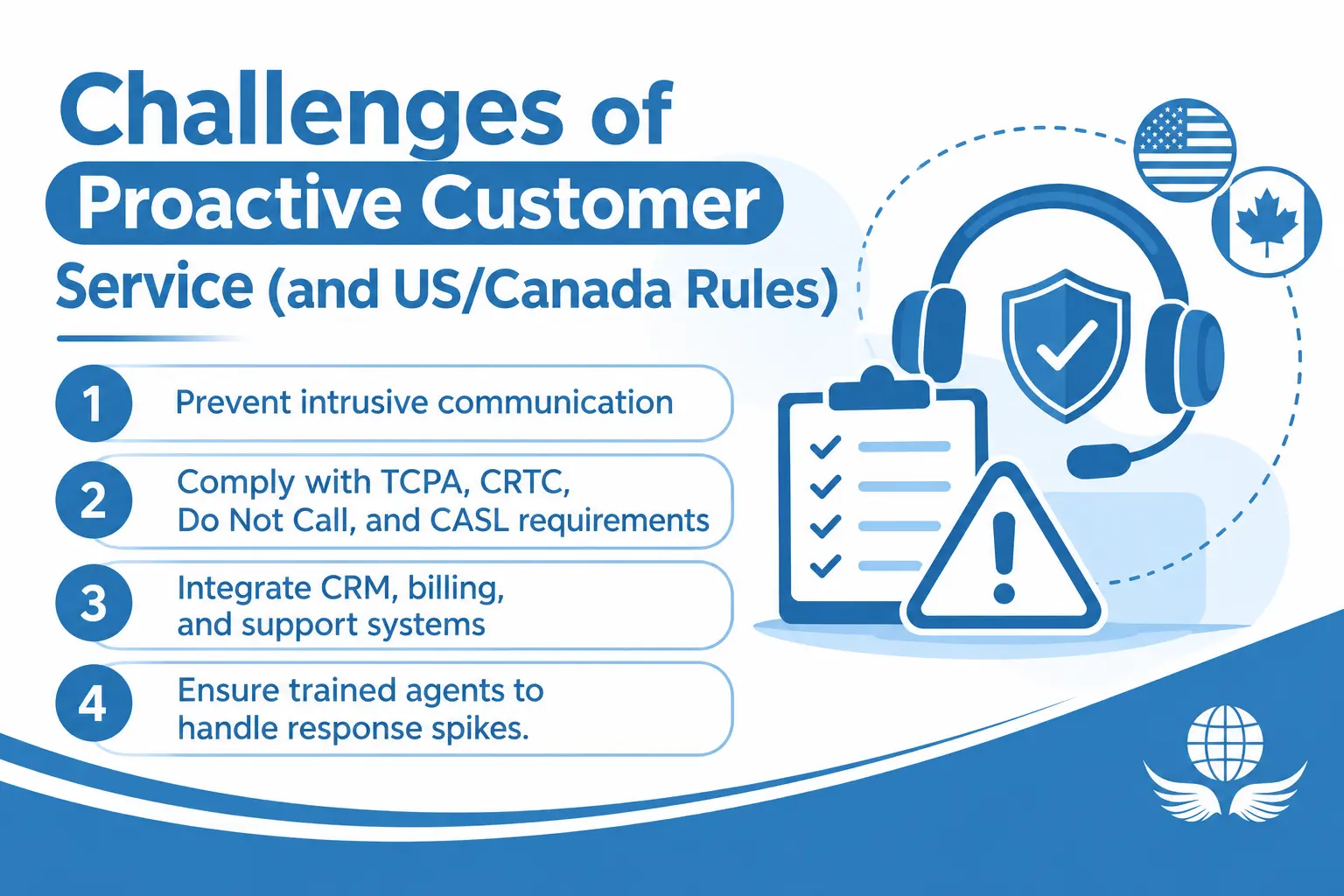
Excessive messages are like spam. Establish a max number of messages and eliminate any promotional stuff they don’t need; give the customer the opportunity to opt out easily and choose the messenger he/she wants to hear from
Consent and Calling Rules in the US and Canada
- United States: FCC’s TCPA rules address consent requirements for autodialed/prerecorded calls and texts, and apply the National Do Not Call Registry for telemarketing calls.
- Canada: Here, telemarketing calls are regulated under the CRTC’s Unsolicited Telecommunications Rules and the National Do Not Call List, and commercial emails and texts are regulated by Canada’s Anti-Spam Legislation (CASL).
A service message (such as an outage alert, a reminder for an appointment, or a fraud check) is not considered marketing communications, but it’s best practice to obtain and document consent anyway. We have a guide to call center compliance that explains more. This information is not intended to be legal advice.
Data Silos
If CRM doesn’t seamlessly communicate with billing and support systems, agents can’t be proactive. These systems should be linked first to ensure that all alerts and conversations are made on the complete customer record.
Staffing and Cost
Extra manpower is required during an outbound program or when there is a spike in alerts. You will still get calls out during an outage notice that is communicated to thousands of customers, and the calls will require trained staff to respond. It is here that a call center partner can come into play.
How to Measure Proactive Customer Service
Pay attention to these metrics in order to determine if your proactive programs are effective.
| Metric | What It Shows | What Good Looks Like |
|---|---|---|
| CSAT | How satisfied customers are after an interaction | Goes up after proactive outreach |
| NPS | How likely customers are to recommend you | More promoters over time |
| Retention or churn rate | Whether customers stay | Churn goes down |
| Inbound contact volume | How many avoidable calls you prevent | Fewer “where is my…” contacts |
| Repeat contact rate | Whether issues are fully solved | Goes down |
| First contact resolution (FCR) | Whether problems are solved on the first try | Goes up |
| Outreach response rate | Whether customers find messages useful | Steady or rising, with few opt-outs |
Look at these measures before and after you begin, using the same customer group. You’ll learn more about these metrics in our guide on how to improve customer satisfaction.
How a Call Center Delivers Proactive Support
A lot of companies do not have the resources or staff to engage in proactive outreach. There are multiple ways in which a call center partner can fill in gaps.
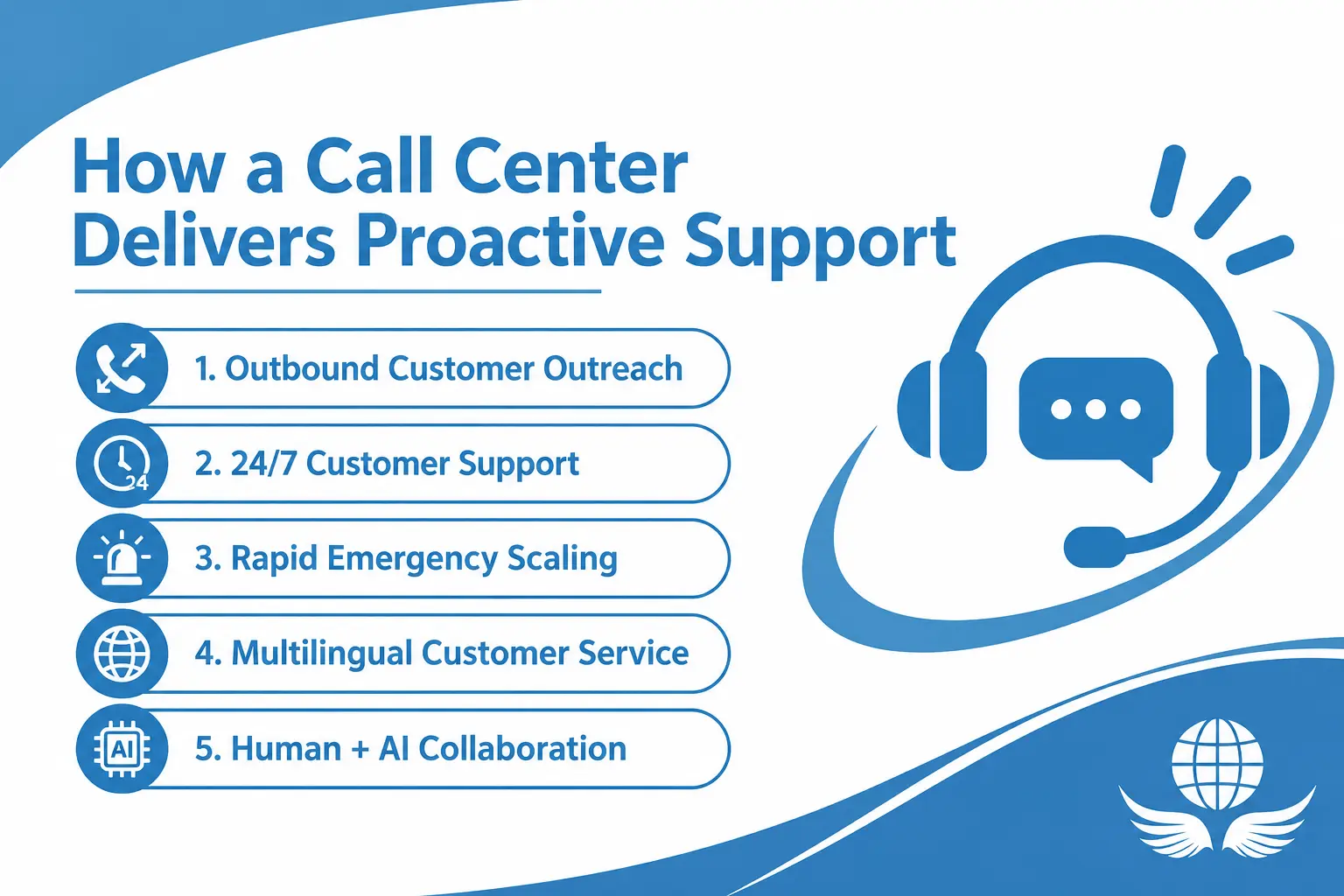
- Outbound programs: Welcome, renewal, retention calls, and appointment reminders.
- Round the clock: Alerts delivered during the night must also be acted upon, and a 24/7 answering service ensures there is someone on the other end of the line.
- Fast scaling: Support for emergency scale-up, in case of outage or recall, adds trained agents fast.
- Multilingual agents: US and Canadian clientele prefer to be dealt with in English, French, or Spanish; business can extend multilingual capacity without local recruiting.
- People plus AI: native speaking agents collaborate with AI agents. Possible problems are identified by the AI and resolved through culturally sensitive message outreach by agents.
Check out our guide to outsourcing call centers for more on language coverage or our guide to multilingual support. Agents Republic offers a set of customer service teams that enable US and Canadian businesses to conduct proactive outreach programs.
Frequently Asked Questions (FAQs).
What is Proactive Support?
Proactive Support is customer support that isn’t waiting for the customer to ask for it but is offered proactively: It uses alerts and reminders for customers, as well as tips and check-in mechanisms, using customer information and their behavior. The aim is to move from ‘reactive’ to ‘proactive’, thereby curbing avoidable calls and frustration.
What Is Proactive Help?
Proactive help is providing assistance before a customer asks for it. Examples of these are a tip about a new feature, an alert about a late order, or a check-in call after set-up. It works best if it is useful to the customer and communicated on a channel they prefer.
What Is an Example of Proactive Support?
An airline that informs passengers of their delay and allows them to rebook before making a call is a common example. Another is a software company that sends setup tips when a new customer has not finished onboarding. See the industry examples above for retail, healthcare, banking, telecom, and technology.
What Is the Difference Between Proactive and Reactive Customer Service?
Proactive customer service is one that contacts the customer prior to a customer’s issuance of a complaint. Reactive customer service is the kind of service offered after the customer reaches out to customer service with a problem.Proactive service prevents unnecessary contacts; reactive service deals with questions that nobody could foresee. Both are needed and must be interconnected in order to provide a full customer experience for most businesses.
What Are Proactive Customer Needs?
Proactive customer needs are those which the customer has not identified or expressed. Some examples of these are a renewal that is due soon, an expiring card or a setting that will generate errors later. Identifying such needs early enables a business to provide assistance before the customer experiences an issue or a dismaying shock.
How Do You Measure Proactive Customer Service?
Track CSAT, NPS, retention/churn rate, and inbound contact volume as proactive customer service metrics. Repeat contact rate, first contact resolution, and outreach response rate provide helpful information. Ensure that the results of your proactive programs are compared both before and after the programs are implemented, to the same group of customers; this will allow you to see the real effect of your proactive effort.
Can an Outsourced Call Center deliver Proactive Customer Service?
Yes. An outsourced call center can operate the outbound welcome and renewal calls, send alerts and follow up on them, and be available around the clock to respond to alerts from customers. It can also grow rapidly during outages. Agents Republic offers proactive business outreach services in multiple languages in the USA and Canada.
Final Thoughts
Proactive customer service changes support from a problem-solving cost to a preventative measure. Prioritize key moments when customers are stuck, leverage data to predict their needs, and test results. Agents Republic, a Vancouver-based BPO company, helps businesses put these programs into action.
Ready to help customers before they ask? Agents Republic runs 24/7, multilingual proactive support for businesses across the US and Canada. Call +1 (604) 210-8100 to get started.