
Key Takeaways
- Your customer support cost per hour is probably double the agent wage after accounting for benefits, unbillable time, and tools.
- Channel mix moves the number more than headcount does because a phone contact and a deflected contact aren’t comparable.
- The cost per ticket is the most important metric. Hourly costs are practically meaningless on their own.
- Repeat contacts are the most expensive support contact type and don’t even appear as a separate contact type.
- Shared minute plans and dedicated coverage plans address different problems, so the cheaper option depends on your volume type.
- Build your own baseline before you ask for even one quote, as you will not know whether a proposal is good without one.
Ask a support leader about their customer support costs, and most will just give you the agent salary. It is an incorrect number and is almost always less than half the true cost.
The wage is just the tip of the iceberg. A median customer service representative hourly wage of $20.59 shows what is deposited to the employee’s account. It does not illustrate the payroll burden, the unallocated hours that cannot be assigned to a contract, the licenses associated with each seat, or what happens when that employee quits after 9 months.
Thus, this guide does not include a rate card. It shows how the number varies by channel type and provides a baseline for each proposal.
Want the calculation for your own operation? Just get a quote, and we can go over this together.
What Does An Hour Of Customer Support Cost You?
Your cost per hour for customer support is 1.9 to 2.2 times each agent’s wage. Many in-house budgets fail here.
Let’s start with wages. Now let’s add your payroll burden, since benefits account for approximately 30% of total compensation costs for private-sector employers. Finally, divide by the total productive hours. Coaching, breaks, training, and absences all account for about 25 to 35% of each work shift.
Next, add the cost of the actual seat. Helpdesk licenses, a phone system, quality tools, and scheduling and support equipment all add to the total cost.
Also, include the supervisor, as every eight to twelve agents requires a dedicated support supervisor. Lastly, consider the hiring and the support ramp, which spans the short length of a typical support employee’s tenure of less than two years.
The real cost is where most teams are unable to build an accurate number. Until you know this number, you cannot read or make sense of any other quotes.
The Wage Is About Seventy Percent Of The Story
Benefits are close to 30% of the employee’s total value. Thus, a $22 salary translates to a total cost of almost $31 before the employee even does one single call. This total value includes all Statutory contributions, paid leave, insurance, and pensions.
The Hours Nobody Can Bill
An agent paid for 2,080 hours a year is not free for 2,080 hours of contacts. On average, training, breaks, coaching, and absence consume from 25% to 35% of each work shift. Thus, the real cost per hour of customer support is the fully loaded wage divided by available hours.
The Seat Behind The Agent
Every agent carries software. Helpdesk seats, phone minutes, QA tooling, scheduling, and reporting. Each one is small. Together they add real customer support cost, and teams almost always leave them out when estimating their own outsourced customer service costs.
All of these software suites cost money and add to companies’ real support costs. Most teams will want to skip these costs when estimating their outsourced support services.
Replacing People You Already Trained
Support staff turnover is high. There are costs associated with time, job postings, interviews, and training. If we average the total cost associated with training and support staff turnover, the result is a high hourly cost.
This is why the cost of outsourced customer support is often more attractive to companies than having an in-house customer support team.
How Does Customer Support Cost Change By Channel?
The support channels used by the support team have the biggest impact on customer support cost. The same customer support question, when answered on the phone versus in a support article, can vary widely.

Benchmarking studies show that the median cost per contact for assisted support channels is $13.50, whereas for support channels that provide articles it is $1.84. There is a large cost difference for deflection.
| Channel | Relative cost per ticket | Why |
|---|---|---|
| Phone | Highest | One agent, one customer, full attention |
| Live chat | Lower | Two to three concurrent conversations |
| Mid | Cheap per message, expensive per thread | |
| SMS and messaging | Lower | Asynchronous, batched by agent |
| Self service | Lowest | No agent time once published |
Phone Is Expensive And Often Unavoidable
Voice ties one agent to one customer for the whole interaction, so it carries the highest customer support cost of any channel.
It also resolves complex issues fastest, which is why cutting phone access usually pushes cost sideways rather than down.
Chat Cuts Cost Through Concurrency
A trained agent runs two or three chats at once, so one salaried hour covers more contacts. Concurrency has a ceiling. Push past three and handle times stretch, quality drops, and customer support cost per contact climbs again.
Email looks cheap and rarely is
A single email reply is inexpensive. A four-message thread is not. Email hides its true customer support cost in back-and-forth exchanges that a two-minute call would have closed.
Self-Service Only Pays When It Resolves
Deflection is the cheapest outcome available. It only counts when the customer stops there. A failed self-service attempt followed by a call costs more than the call alone, because you paid for both.
What Pushes Your Cost Per Ticket Up Or Down?
Four operational numbers decide your customer support cost. None of them appear on a vendor quote.
Contacts Per Customer
Confusing onboarding, unclear billing and thin help docs all create contacts. Cut the reasons people write in, and customer support costs fall with them. Onboarding and user experience significantly impact the volume and cost of user support interactions.
First Contact Resolution
It costs a company twice as much to provide or support on the same issue when there is a second support contact.
Repeat contacts are the most expensive unseen part of an organization’s support costs. It is uncommon for support reporting systems to capture support interactions for the same issue.
Average Handle Time
Longer contacts cost more, but chasing that number backwards is a trap. Cutting handle time without fixing resolution turns one long contact into two short ones.
Volume Predictability
Highly predictable support volume enables a support team to be optimally staffed. Our Erlang staffing calculator shows how sharply required headcount moves when arrival patterns change.
Which Pricing Structures Do Support Partners Use?
Six structures dominate customer service outsourcing pricing. What separates them is not the rate. It is what each one quietly rewards.
| Structure | You pay for | It rewards | It breaks when |
|---|---|---|---|
| Per minute | Live talk time | Efficiency | Volume spikes |
| Cost per ticket | Each resolved contact | Throughput | Tickets get split |
| Coverage hours | Agreed schedule | Availability | Queues sit quiet |
| Managed service pricing | One bundled fee | Simplicity | You need to audit it |
| Outcome-based pricing | Delivered results | Quality | Data is not trusted yet |
| Hybrid pricing | Base plus variable | Flexibility | Nobody tracks both halves |
When Cost Per Ticket Works Best
Per ticket works best for queues with predictable complexity. Make sure you know what is counted as a ticket before you sign the agreement.
If a reopened case is billed as a new ticket, your customer support outsourcing costs rise while your volume stays flat.
When Managed Service Pricing Makes Sense
Managed service pricing bundles agents, supervision, and technology into a single price. This structure is the easiest to approve but the hardest to check.
Ask what lies within the bundle. Otherwise, you are unable to determine where your money is going within your customer support outsourcing costs.
Where Outcome-Based Pricing And Hybrid Pricing Fit
Outcome-based pricing sets payment based on resolved cases or customers retained, meaning both sides would need clean reporting.
Hybrid pricing would work best for seasonal demand. For both, you would have to do more audits. Use them after a relationship is formed rather than at the beginning.
How Does Agents Republic Structure Customer Support Cost?
Two structures, selected based on how your volume is shaped rather than how it is sized.
Shared Plans, Billed By The Minute
Shared support handles basic, repetitive calls via agents who serve multiple clients. All plans are for English only. Prices are available in detail on our phone answering service.
| Plan | Monthly | Minutes | Coverage | Channels |
|---|---|---|---|---|
| Bronze | $250 | 200 | 8 hours, 5 days | Phone |
| Silver | $550 | 500 | 12 hours, 5 days | Phone, email, chat |
| Gold | $950 | 1,000 | 24/7 | Phone, email, chat, SMS |
| Platinum | $1,950 | 2,500 | 24/7 | Phone, email, chat, SMS |
Here is the reading that matters. Spread those minutes across the coverage each plan buys, and you get the daily allowance you are actually purchasing.
| Plan | Minutes per business day | Roughly equal to |
|---|---|---|
| Bronze | About 9 | Three short calls |
| Silver | About 23 | Seven or eight contacts |
| Gold | About 33 | A steady trickle, day and night |
| Platinum | About 82 | A small queue running constantly |
Are you already exceeding the top-line numbers? Then a plan based on per-minute charges won’t help, and coverage pricing will reduce the cost of your outsourced customer support. That threshold tells you more than any headline rate does.
Our plans begin with a promotional 330-day period at prices ranging from $99 for Bronze to $999 for Platinum, and setup takes around 20 minutes to complete the six steps, making this the basis of our virtual receptionist for small businesses.
Dedicated Team, Billed by Coverage
Dedicated Support is a great option for complex, multi-channel, or technical work.
Support agents will only work on your account, learn your product, and use your CRM and knowledge base at no additional cost. They also cover more than 100 languages, which shared plans do not.
Agent hourly rate × required coverage hours + a fixed monthly supervision fee.
The hourly rate will depend on location, experience, language, and skill. Those four will determine your customer support outsourcing cost.
Technology will be added if needed. One thing to note: the agent line tracks coverage hours, so February bills lower than a 31-day month.
If you need help with sizing, feel free to contact our call center support services team. You can also read our guide on customer support outsourcing from beginning to end.
How Do You Build Your Own Customer Support Cost Baseline?
This can be a great starting point before you even send out requests for quotes. This will take you approximately one afternoon to complete.
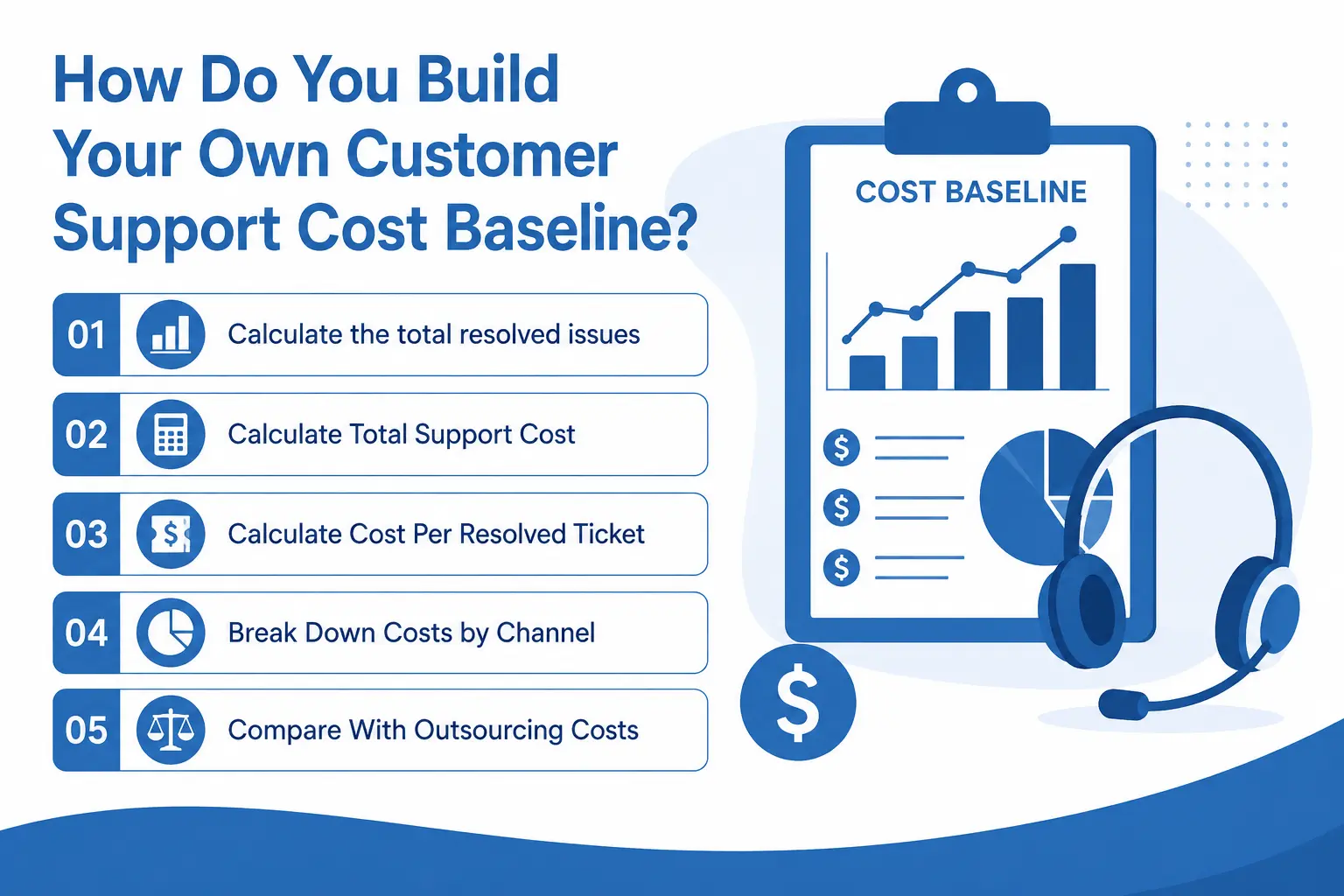
- Calculate the total number of resolved issues, not tickets that were logged. Combine duplicates and reopened issues to get the total number of resolved issues.
- Calculate the total cost of support for the given year.
- The current cost per resolved ticket is the total amount spent divided by the total number of resolved tickets. This number is usually higher than what is anticipated.
- Break down the total spent by channel. Compare phone, chat, and email channels. These numbers indicate where the effort is needed most.
- Set the same numbers with a partner. Now, customer service outsourcing pricing is a comparison, not an estimate. The time to inquire about outsource customer service cost is now, not before.
The most important aspect of the process is the baseline. Without this, the outsourced customer service cost is just a number that you have no control over.
Final Thoughts
Customer support costs seem more complicated than they are. Start with a channel-specific baseline and measure issues that have been resolved rather than tickets. This provides quick clarity.
From there, the choice is practical. Match the structure to the shape of your volume. Always prioritize first contact resolution. Treat any customer service outsourcing pricing you cannot reduce to cost per ticket as incomplete.
Ready to see the numbers for your own queues? Request a quote or call +1 (604) 210-8100.
Frequently Asked Questions (FAQs)
What is a realistic customer support cost per ticket?
The median is $13.50 for assisted support and $1.84 for self-service support. The complexity, the support language, and the support channel also affect these numbers.
To calculate this, total spend for the last 12 months must be divided by the total number of issues resolved. The number matters when comparing customer service quotes, rather than industry averages.
Is outsourcing cheaper than hiring in-house?
Yes, though the savings are defined by what you don’t spend after hiring. Customer service outsourcing costs are lower than hiring in-house customer service because staffing costs collapse into a single line. This advantage is lost if a partnership is not formalized, as scope creep erases the difference.
Why does my customer support cost rise when volume stays flat?
Generally, this happens because of repeated contacts. Your average number of customers may stay flat, but customers tend to generate more support requests for problems that your support team is unable to resolve on the first attempt. Channel drift may also be a factor, since your self-service channel may be used less frequently.
Which structure suits a business with unpredictable volume?
Support contracts that charge per minute of contact are better during slow periods because you only pay for the time an agent is engaged. During busy periods, coverage pricing works out to be less per support contact, because the volume becomes more predictable and consistent.
Does multilingual support change customer service outsourcing cost?
Yes, significantly. In less common languages, the hourly rate for native speakers will be much higher due to the smaller talent pool. They will also resolve support issues quicker, resulting in fewer market-related support contacts. As a result, the average cost of resolving support issues in the non-English market will be lower than the hourly support cost.
What should I budget beyond the quoted figure?
You should expect to spend funds to cover the ramp-up period, as it takes a new support team 30 to 90 days to get up to speed on the support required to deliver quality service. You should also plan to spend some time managing the new support team, as this time is not visible on an invoice.

